
Last Updated: November 21, 2026
Quick Summary
Portable sanitation planning starts with one standard unit per 50 guests for events of four hours or less, tightening to one per 35 to 40 guests for six to eight hours. Cut the guest-per-unit ratio by roughly a third when alcohol is served, then add 10 to 15 percent for sharp peaks.
- For events beyond eight hours or multi-day festivals, plan on one unit per 25 guests plus servicing stops.
- Pair restrooms with handwashing stations, usually one station per restroom cluster, at any event serving food.
- Plan at least one ADA-compliant unit per restroom cluster on a firm, level, accessible route.
- Allow a service lane at least 10 feet wide with overhead clearance so pump trucks reach every cluster.
- Schedule one mid-event servicing stop for single-day events and daily pumping before gates open for multi-day festivals.
Table of Contents
- Start With Guest Count and Event Duration
- Using a Portable Restroom Rental Calculator
- Standard Units, Restroom Trailers, and ADA-Compliant Portable Restrooms
- Portable Restroom Placement and Site Logistics
- Building an Event Restroom Service Schedule
- Handwashing Stations, Waste Capacity, and Contingency Planning
- Budgeting and Itemized Cost Drivers
- Request a Quote and Lock In Your Unit Count
- Frequently Asked Questions
Start With Guest Count and Event Duration
The number of portable sanitation units your outdoor event needs comes down to two numbers: how many guests will attend and how long they will stay. Everything else, from alcohol service to peak-hour clustering, adjusts those two figures up or down. This guide walks through the math, the unit types, and the site logistics that keep a crowd comfortable.
Get the base count wrong and no amount of servicing saves you. Get it right and the rest of the plan falls into place.
The Base Formula: Units per Guest
A common planning approach is one standard unit per 50 guests for an event lasting four hours or less. For events running six to eight hours, many planners tighten that to one unit per 35 to 40 guests. Beyond eight hours, or across multi-day festivals, planners often plan on one unit per 25 guests and add servicing stops.
These are starting points, not rules. A three-hour corporate lunch and an eight-hour music festival with the same headcount need very different portable sanitation setups.
Adjusting for Alcohol, Food Service, and Peak Hours
Alcohol service changes the math more than any other variable.
Food service adds a second pressure point: handwashing. Any event serving food should pair restrooms with handwashing stations, and full-service catering usually calls for one station per restroom cluster.
Peak hours matter too. Arrival, set breaks, and the final hour before close create short bursts of demand that a flat average hides. Spread units across restroom clusters so no single queue absorbs the whole surge.
Using a Portable Restroom Rental Calculator
A portable restroom rental calculator turns guest count, event duration, and service variables into a starting unit count. Most calculators follow the same logic: base ratio, then duration multiplier, then adjustments for alcohol, food, and accessibility. The output is a planning number, not a final quote.
Here is how the calculation works by hand for a 500-guest, six-hour event with beer and wine service and a catered meal:
| Step | Variable | Planning Input | Math | Running Unit Count |
|---|---|---|---|---|
| 1 | Base ratio | 500 guests, 6-hour event | 500 ÷ 40 guests per unit | 13 units |
| 2 | Alcohol adjustment | Beer and wine service | 13 × 1.33 (roughly a third more) | 17 units |
| 3 | Peak-window buffer | Arrival and headliner set | Add 10% for surge clustering | 19 units |
| 4 | Accessibility | ADA-compliant units required | At least 1 per cluster, 4 clusters | 4 accessible units (included in total) |
| 5 | Handwashing | Catered meal | 1 station per restroom cluster | 4 stations |
| 6 | Contingency | Standby reserve | 1-2 spare units | 20-21 units total |
Run the numbers, then round up. A slightly oversized order costs less than a line of guests waiting at the wrong moment.
Adjusting the Calculator for Your Event Type
The same calculator produces different answers depending on event type, because the variables shift.
Planners generally find that the calculator is only as good as the inputs.
Watch out: calculators that ask only for guest count and duration will undercount any event with alcohol, food service, or a fixed peak. Always run the adjustments manually and confirm the output against your site plan before you request a quote.
From Calculator Output to Vendor Quote
The calculator gives you a planning number. Your vendor quote confirms it. Send the vendor your guest count, event duration, alcohol and food plans, accessibility needs, and site layout, and ask them to show how their recommended count maps to the same variables. A vendor who can walk through the math with you is more likely to size the order correctly than one who quotes a flat package.
Standard Units, Restroom Trailers, and ADA-Compliant Portable Restrooms
Three portable sanitation options cover most outdoor events: standard units, restroom trailers, and ADA-compliant portable restrooms. Each fits a different crowd, budget, and guest expectation. Our advice on choosing the right portable toilet rental starts with matching the unit to the event, not the other way around.
Standard units are the workhorses of outdoor sanitation. They handle volume well and are generally the lowest-cost option per guest served.
Restroom trailers bring running water, lighting, and climate control, which makes them a fit for weddings, corporate galas, and other high-end events where guest comfort is part of the experience.
ADA-compliant units are required wherever guests with mobility needs will attend.
Pros and Cons of Each Sanitation Option
| Option | Pros | Cons | Best For |
|---|---|---|---|
| Standard unit | Lowest cost per guest, high capacity, easy to place | No running water, basic comfort | Festivals, construction sites, casual events |
| Restroom trailer | Running water, lighting, climate control, premium feel | Higher cost, needs level ground and power | Weddings, corporate events, high-end gatherings |
| ADA-compliant unit | Meets accessibility needs, required by planning standards | Takes more space, needs a firm accessible route | Every event with guests who use mobility aids |
Best for: standard units suit large, casual crowds. Skip if: your event is a black-tie wedding where guest comfort drives reviews.
Portable Restroom Placement and Site Logistics
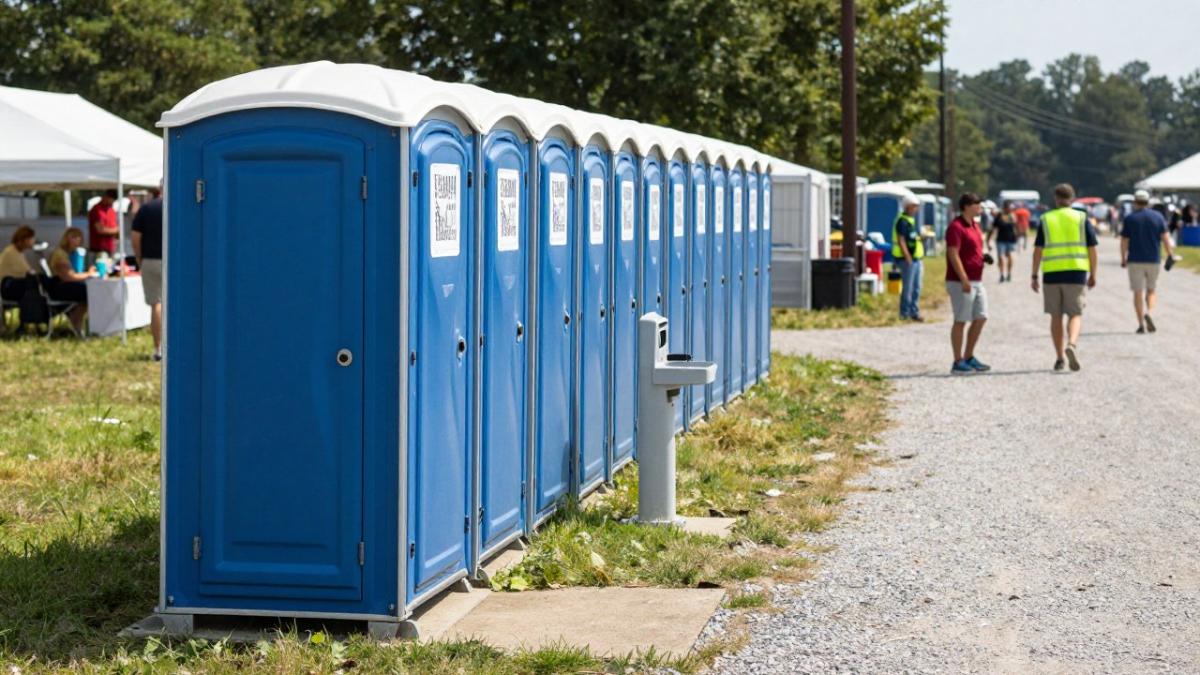
Placement decides whether your unit count actually works. A generous order clustered in one far corner still produces long lines. Distribute restrooms in clusters across the site, with each cluster serving a zone of the crowd.
Vehicle Access and Ground Conditions
Pump trucks and delivery trailers need a route to every cluster. Plan a service lane at least 10 feet wide with overhead clearance for the truck, and confirm the ground can support the weight of a loaded truck, saturated grass after rain will not. Gravel, packed dirt, or a paved path is safer than turf. If your site has a slope, place units on the flattest available ground and orient doors to face downhill so guests step out onto level footing.
Queue Space, Lighting, and Accessible Routes
Each cluster needs queue space in front of the doors, roughly 3 to 4 feet per person in line, so a 10-person queue needs 30 to 40 feet of clear space. Keep that space out of main walkways so lines do not block traffic. For evening events, light the queue and the path to the units; guests will not use restrooms they cannot see safely. Every cluster should have a firm, level, accessible route from the main gathering area to the ADA-compliant unit, with no grass, gravel, or curb between the route and the door.
Keep these placement rules in mind:
- Put clusters within sight of main gathering areas, not hidden behind stages
- Keep a clear, accessible route to every unit, including ADA-compliant ones
- Place handwashing stations at the exit of each cluster
- Reserve a service lane so pump trucks can reach units without crossing crowds
- Space clusters so no guest walks more than a few minutes to the nearest restroom
- Avoid placing units downhill from food service or drainage areas
Placement by Event Type
A wedding with a single reception area needs one central cluster near the tent, plus an accessible unit on the main path. A festival with multiple stages needs clusters between stages so guests can use the nearest restroom without missing a set. A corporate event with a short arrival window needs extra units near the entrance and parking area, because that is where the first surge hits.
Our outdoor event checklist covers the wider site plan, including placement, handwashing, and waste logistics.
Building an Event Restroom Service Schedule
A service schedule keeps portable sanitation clean through the event, not just at delivery. For a single-day event, plan one servicing stop mid-event on high-traffic clusters. Multi-day festivals need daily pumping and restocking, typically scheduled in early morning before gates open.
Build the schedule around your peak windows. Coordinate restroom servicing with dumpster pickup so both happen in the same window, which is the approach we outline in our guide to portable toilets and dumpsters for event planners.
Handwashing Stations, Waste Capacity, and Contingency Planning
Handwashing stations belong at every event serving food or drink. If you are unsure how they work, our guide on how portable hand washing stations work explains the fresh water and waste tanks.
Waste capacity is the quiet failure point. Standard units hold a finite volume, and a hot day with heavy attendance fills tanks faster than the schedule assumes.
Watch out: ordering the exact calculated count with no buffer leaves no room for a broken unit or an unexpected surge. A small reserve prevents the worst-case line.
Budgeting and Itemized Cost Drivers
Portable sanitation pricing depends on quantity, dates, delivery distance, and service frequency. Current pricing is available from Site Services USA on request. What we can do is show you the cost drivers so your budget holds up.
The main drivers are unit quantity, rental duration, delivery and pickup distance, servicing frequency, and unit type. Trailers cost more than standard units; ADA-compliant units and handwashing stations add line items.
Request a Quote and Lock In Your Unit Count
The math gets you a planning number. A quote confirms it.
Site Services USA provides nationwide coverage, with same-day emergency service available and ADA-compliant portable sanitation options. When you are ready, request a quote for event portable toilet rental and lock in your unit count before the date fills.
Most event planners discover their restroom shortfall on the day itself, when nothing can be fixed. Size the order early, place the clusters with the crowd in mind, and build servicing into the schedule from the start.
Frequently Asked Questions
How many portable toilets do I need for an outdoor event?
A common starting point is one standard unit per 50 guests for a four-hour event without alcohol, tightening to roughly one per 25 to 35 guests when alcohol is served or the event runs longer. Add units for peak arrival windows, and count ADA-compliant units separately as part of the total. Use a portable restroom rental calculator to test your numbers against guest count and event duration before you request a quote.
Where should portable toilets be placed at an outdoor event?
Place restroom clusters within a short walk of the main activity areas but downwind of food service and stages. Keep units on firm, level ground with a gravel or paved access path so service trucks can reach them. Spread clusters across large sites instead of concentrating them in one spot, and always keep an accessible route to ADA-compliant portable restrooms clear of grass, mud, and vendor tents.
How often should portable restrooms be serviced during an event?
Build your event restroom service schedule around attendance and duration. Most single-day events need at least one servicing visit, and large or multi-day festivals often need mid-event pumping and restocking. Schedule servicing during low-traffic windows, confirm the pickup time in writing, and keep a printed sanitation checklist so you can verify waste capacity, supplies, and handwashing stations between visits.
Do outdoor events need handwashing stations?
Yes, especially when food service or alcohol is part of the program. Pair handwashing stations with restroom clusters and place extra units near food vendors and prep areas. Match handwashing capacity to guest count the same way you size restrooms, and confirm the service schedule covers refills and wastewater removal so stations stay usable through the final hour of the event.
What portable restroom options are available for outdoor events?
You can choose from standard units, luxury restroom trailers, and ADA-compliant portable restrooms. Standard units handle casual crowds and tight budgets, trailers suit high-end events, and accessible units are required for guests with disabilities. Many planners mix all three, using trailers near VIP areas and standard units at the perimeter, then confirm delivery, pickup, and servicing terms with one vendor.
