
Last Updated: November 22, 2026
Quick Summary
The right temporary fencing solutions for festival safety start with matching panel type to crowd size, site layout, and risk level. Chain-link panels suit perimeter security, steel barriers direct visitor flow and queue lines, and plastic mesh covers low-risk boundaries. Draw the site plan before renting so panel counts follow from your layout.
- Chain-link panels are typically about 6 ft tall and need anchoring and bases.
- Steel barriers stand about 40 in and are not a security perimeter.
- Every event needs at least two clearly marked exits with clear egress lanes.
- Confirm in writing who installs, inspects, and removes the fencing.
- Recheck anchoring after rain and bracing before any storm forecast.
Table of Contents
- Choosing Temporary Fencing Solutions by Panel Type and Event Size
- Festival Crowd Control Barriers for Visitor Flow and Queue Management
- Festival Fence Layout and Access Points: Entry, Exit, and Safe Zones
- Temporary Fence Panel Rental: Delivery, Installation, and Inspections
- Temporary Fencing Permit Requirements and Safety Compliance
- Protecting Restricted Areas and Backstage Perimeter Security
- Request a Quote and Lock In Your Festival Fencing Plan
- Frequently Asked Questions
Choosing Temporary Fencing Solutions by Panel Type and Event Size
The right temporary fencing solutions for festival safety start with matching panel type to crowd size, site layout, and risk level. Site Services USA supplies modular fencing nationwide, and organizers who pick panels before they map the site often end up renting twice.
Temporary fencing is a modular barrier system of linked panels that defines event boundaries, channels foot traffic, and protects restricted areas without permanent construction. Getting the type right matters more than the quantity. Here is how the three main options compare.
Chain-Link Panels, Steel Barriers, and Plastic Mesh Compared
Chain-link panels are the workhorse. Chain-link panels are typically used on weighted bases and link into continuous runs. They are well suited to perimeter security and overnight containment. The trade-off: they look industrial, and they need proper anchoring.
Steel barriers, often called crowd control barriers or metal barricades, are the interlocking units you see along parade routes and stage fronts. They are used to direct visitor flow and form queue lines. They are not a security perimeter. A determined crowd can move them.
Plastic mesh fencing is the budget option for low-risk boundaries: vendor areas, overflow parking, decorative separation. It is a lower-cost option for low-risk boundaries, and it moves in wind unless anchored well.
Many layouts mix types: chain-link for the hard perimeter, steel barriers for crowd-facing lines, and mesh for the soft edges.
For a fuller breakdown of panel choices, see our overview of temporary fencing options, and if you want a deeper comparison, our guide to choosing the right fencing type walks through it step by step.
| Panel Type | Best For | Typical Height | Watch Out For |
|---|---|---|---|
| Chain-link panels | Perimeter security, overnight containment | About 6 ft | Needs anchoring and bases |
| Steel barriers | Crowd control, queue lines, stage front | About 40 in | Not a security perimeter |
| Plastic mesh | Low-risk boundaries, vendor areas | Varies | Moves in wind, stops no one |
Festival Crowd Control Barriers for Visitor Flow and Queue Management
Crowd control barriers help tell people where to walk. Set them in straight, predictable lines and foot traffic moves; set them in confusing zigzags and you create the crush points you were trying to prevent.
A common mistake is treating ticket lines as an afterthought. In practice, the entry queue is where crowd pressure builds first. Plan queue lanes with enough width for strollers and wheelchairs, and angle them away from the main walkway.
For stage-front crowd management, barriers need to be linked and footed, never loose. Leave designated gaps for medical and security access, and keep those gaps staffed.
Festival Fence Layout and Access Points: Entry, Exit, and Safe Zones
Layout is where festival fencing succeeds or fails. Draw the site before renting panels: mark entry points, exit routes, safe zones, and emergency access lanes, then size the fence runs to that map.
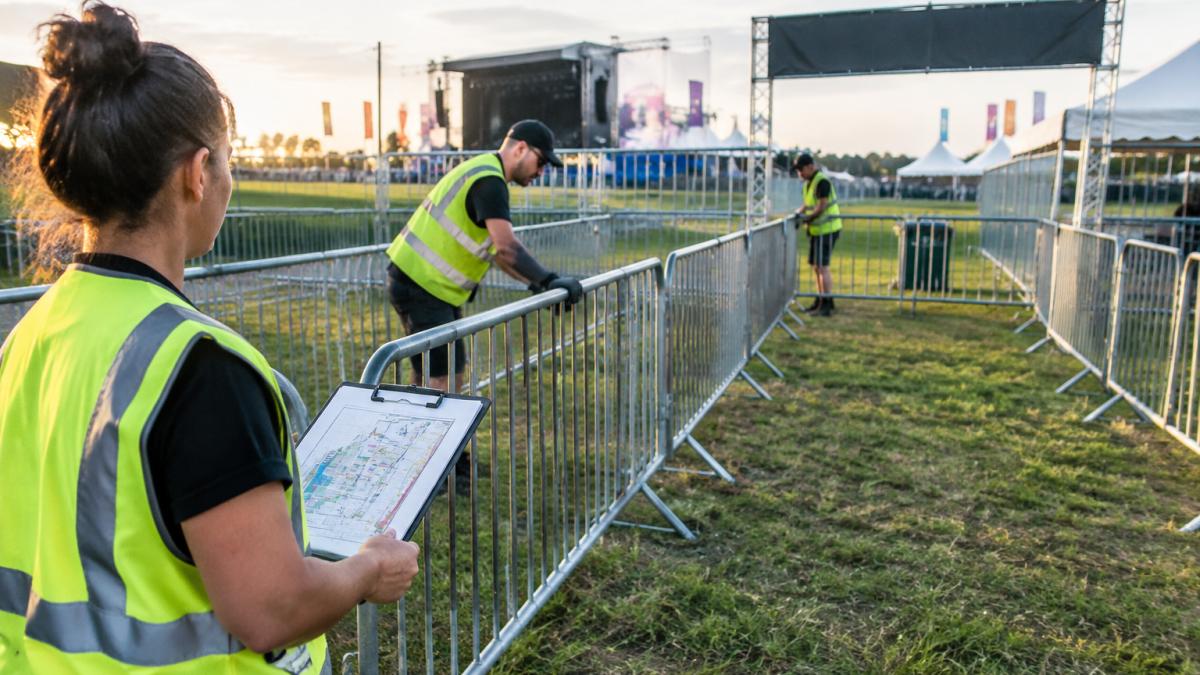
Every event needs at least two clearly marked exits, and emergency egress lanes must stay clear of fencing, vendors, and signage. Safe zones for medical and lost-child reunification belong inside the perimeter but away from stage crowd pressure.
Capacity-Based Planning and Inclusive Crowd Routing
Size your layout to your crowd capacity, not to last year’s photos. Start with the occupancy figure your venue or fire authority will hold you to, then work backward through the geometry:
- Gate and entry-lane count. Divide expected peak-hour arrivals by the throughput you can realistically process per lane. Ticket scanning, bag checks, and credential checks each add time, so a lane’s throughput drops once screening is added. Plan lanes for the peak arrival window, not the daily average.
- Aisle and walkway width. Main walkways need enough width for two-way flow plus emergency access. A common pattern is to keep primary aisles wide enough for a loaded responder cart or ambulance stretcher to pass without clearing crowds first, and to reserve narrower connector paths for secondary circulation.
- Barrier count from geometry. Once gate widths, aisle widths, and perimeter length are set, panel counts follow directly. This is why mapping first prevents the rent-twice problem: a layout drawn to capacity tells you the run lengths before you order.
- Arrival-peak staging. Use steel barriers to create staged holding areas outside the gate so early arrivals queue in defined lanes rather than pressing against the fence line. Reconfigurable barrier runs let you open additional lanes as the arrival curve peaks and close them as it tails off.
Inclusive routing means accessible paths from every entry point to every major area, with firm ground under wheelchair routes. Plan at least one accessible entry lane at each gate, keep its width clear of barrier feet and signage, and route accessible viewing areas so they connect to the same circulation spine as everything else.
Watch out: queue lanes that double back on themselves create the crush points the barriers were meant to prevent. Angle queue runs away from main walkways and avoid dead-end pockets where a surge has nowhere to go.
Emergency Egress and Responder Access
Barriers guide crowds, but they must never trap them. Walk every egress route on the site plan and confirm that each one stays clear from the stage or main attraction to the exit gate. Keep responder access lanes marked and staffed, and make sure gate staff know how to open or remove a barrier run quickly if an evacuation is called. Document the egress plan and share it with the event safety team and local responders before gates open.
Temporary Fence Panel Rental: Delivery, Installation, and Inspections
Rental is often the practical choice for festivals, since it avoids long-term storage of panels between events.
Ask three questions before you book: who installs, who inspects, and who removes. Professional installation matters because panels that lean or sit on soft ground fail when crowds press against them. Confirm in writing who owns each step between delivery, setup, and event-day inspection.
Installation Sequence That Holds Up Under Crowd Load
A fence line is only as strong as its weakest panel and its weakest base. A practical setup sequence most crews follow:
- Stake the line from the site map. Mark panel positions and gate openings before any panel lands, so runs follow the plan rather than the easiest path.
- Set bases and level the run. Weighted bases go down first on hard surfaces; on grass and gravel, use ground stakes or ballast suited to the surface. Step panels on slopes so each panel sits level rather than leaning.
- Link and brace. Connect panels at every joint and add bracing at corners, gate posts, and any run that faces open ground where wind can load it.
- Gate and gap check. Confirm every gate opens freely, every medical and security gap is staffed, and no gap is wide enough to slip through unintentionally.
- Walk the full perimeter before gates open. Check links, bases, and bracing end to end, and log the walk.
Ground Conditions, Anchoring, and Wind-Load Checks
Ground conditions decide anchoring. Asphalt takes weighted bases well; grass and gravel need deeper anchoring or ballast, and slopes need panels stepped and braced. Soft ground after rain is the common failure point: bases that held on dry grass can sink or shift once the surface saturates, so recheck anchoring after any significant rain.
Wind is the quiet risk: empty fence runs catch gusts like sails, so check bracing daily and before any storm forecast. Long, unbroken runs and fence lines at the edge of open ground take the most wind load. Where a run is exposed, add bracing or break the run with a return or corner rather than leaving one long sail.
Inspection and Maintenance Checklist
Build an inspection routine into the event schedule rather than treating setup as a one-time task:
- Daily perimeter walk. Check every base, link, and brace; log anything loose and fix it before gates open.
- Gate and gap audit. Confirm gates latch, open fully, and stay staffed during peak hours.
- Post-weather check. After wind or rain, re-walk exposed runs and soft-ground sections before admitting crowds.
- Incident log. Record any panel that shifts, leans, or fails, and note the fix. A written log supports both event safety reviews and any post-event debrief with the venue or permitting authority.
Watch out: a fence run that looks fine at setup can loosen once crowds lean on it through a full day. Schedule a mid-event walk during the busiest hours, not only the morning check.
Temporary Fencing Permit Requirements and Safety Compliance
Permit rules vary by city, county, and venue, so confirm requirements with your local permitting office before delivery.
Compliance is not just paperwork. Fire codes typically govern exit width and egress clearance, and the Occupational Safety and Health Administration sets workplace safety standards that apply to event staff working the perimeter. Our safety with temporary fencing page covers the practical side of meeting those requirements.
Protecting Restricted Areas and Backstage Perimeter Security
Restricted areas typically call for a more substantial fence line than public zones, such as chain-link panels with controlled access points.
Access control works best in layers: a perimeter fence, a gate with a credential check, and a secondary barrier around the most sensitive zones. Keep unauthorized access routes in mind too. Fence lines near parking, loading docks, and vendor compounds are the ones people slip through.
Request a Quote and Lock In Your Festival Fencing Plan
Locking in fencing early protects your layout, your delivery window, and your budget. Pricing depends on quantity, dates, and delivery distance, so request a quote built around your site plan for current prices.
Site Services USA offers nationwide delivery and pickup, same-day emergency service, and personalized support. Pair fencing with our project and event management support and you get one vendor for the perimeter, not three.
Festival fencing fails when it is rented last, sized by guesswork, and inspected never. Send us your site plan and dates, and we will match panel types and quantities to your crowd capacity. Get started with Site Services USA and lock in delivery, installation support, and removal before your gates open.
Frequently Asked Questions
What type of temporary fencing is best for a festival?
It depends on the zone. Chain-link panels suit perimeter security and restricted areas, interlocking steel crowd control barriers work best for entry lanes and front-of-stage lines, and plastic mesh or vinyl panels fit lower-risk boundaries and decorative edges. Most festivals combine all three rather than choosing one. Match the panel to crowd pressure, sightlines, and how fast crews need to install and remove it.
Do you need a permit to put up a temporary fence?
Often yes, but it varies by jurisdiction and site. Temporary fencing permit requirements can cover zoning, fire code egress, right-of-way use, and inspections, and large events usually need a site plan showing fence lines and exit routes. Contact the local permitting office and fire marshal early, confirm what drawings they want, and keep approved plans on site. Your rental provider can supply layout details to support the application.
How should temporary fencing be placed to manage festival crowds?
Plan festival fence layout and access points around capacity, not guesswork. Separate entry, exit, and emergency routes, keep lanes wide enough for strollers and wheelchairs, and angle barriers so crowds cannot build pressure against a single point. Add buffer zones in front of stages and leave marked gaps for medical and fire access. Walk the layout with your security lead before gates open.
How can temporary fencing help prevent crowd surges?
Barriers break a large crowd into smaller, directed streams. Pair the layout with trained staff at each access point and a clear emergency egress plan. Fencing directs foot traffic; staffing and planning keep it safe.
