
Last Updated: November 5, 2026
Quick Summary
Portable restroom maintenance is the scheduled work of cleaning, pumping, restocking, and inspecting portable toilets so they stay sanitary, usable, and compliant. Build the schedule around tank capacity, user volume, event peak demand, and weather rather than a fixed calendar, and service more often when unsure. An extra visit costs less than a shutdown.
- OSHA requires at least one toilet for every 10 workers on a construction site.
- Above roughly 85°F, bacteria activity and odor accelerate, so add one extra service visit.
- Dose the tank with a deodorizer at every service and keep the vent clear.
- Set a pump-out trigger below full capacity so units are never serviced at the brim.
- A useful service record captures the unit, date and time, tasks, supplies, and defects.
Table of Contents
- Why Portable Restroom Maintenance Decides Site Compliance
- OSHA Portable Toilet Requirements for Construction Sites
- How Often Should a Porta Potty Be Serviced? A Practical Frequency Calculator
- The Portable Restroom Maintenance Checklist Every Crew Needs
- How to Prevent Porta Potty Odors Before They Start
- Technician Safety, PPE, and Chemical Dosing Done Right
- Digital Records, Route Monitoring, and Troubleshooting Common Failures
- Request a Maintenance Quote for Your Next Project
- Frequently Asked Questions
Why Portable Restroom Maintenance Decides Site Compliance
Portable restroom maintenance is the scheduled work of cleaning, pumping, restocking, and inspecting portable toilets so they stay sanitary, usable, and compliant. Crews often treat service as an afterthought, and compliance problems can follow.
The stakes go beyond smell. A neglected unit becomes a health hazard, a complaint magnet, and an inspection finding. OSHA rules on sanitation exist for a reason, and inspectors check them.
Here is the core tension most guides miss. You cannot clean your way out of a bad service schedule. A unit pumped too rarely will fail no matter how often someone wipes the seat. Maintenance is a system, not a chore.
Below, we break down the seven best practices we recommend for 2026, from OSHA ratios to odor control to recordkeeping. For the broader compliance and cleaning context, our ultimate guide to portable toilets for construction covers the groundwork.
OSHA Portable Toilet Requirements for Construction Sites
OSHA requires at least one toilet for every 10 workers on a construction site. That is the baseline, and it comes from the sanitation standard at OSHA’s sanitation requirements for construction. Crews above 20 workers need separate units for each sex, or at least one dedicated unit.
The ratio is only half the story. Inspectors also look at whether units are clean, stocked, and serviced. A site can meet the count and still fail on condition.
Watch out: the biggest mistake is counting bodies at the start of a project and never revisiting the number. As crews ramp up, the ratio quietly slips. Recount every time headcount changes. To work through the exact math by crew size and shift length, use our guide on calculating OSHA portable toilet requirements.
How Often Should a Porta Potty Be Serviced? A Practical Frequency Calculator
Service frequency depends on users, heat, and unit count, so no single calendar schedule fits every site. Confirm a schedule for your site when you request a quote. The right frequency depends on users, heat, and unit count, not a fixed calendar.
Most guides stop at that rule of thumb. Service intervals should be tied to the variables that fill a tank and drive odor, so the schedule can be defended to a site superintendent or an inspector.
The Four Variables That Set Service Frequency
- Tank capacity. Tank capacity varies by unit type, and the working volume before a pump-out is lower than the tank’s nominal capacity. Set a pump-out trigger below full capacity so a unit is not serviced at the brim.
- User volume. Estimate daily users per unit, not total site headcount. A 40-worker site with four units averages 10 users per unit per day; the same site with two units averages 20. Use the per-unit number in any schedule.
- Event duration and peak demand. A one-day event with 500 attendees is not the same load as a five-day event with 100 attendees per day. Peak-hour demand matters more than the daily total because restocking and odor spike when a unit is hit repeatedly in a short window.
- Weather. Above roughly 85°F, bacteria activity and odor accelerate, and users drink more, which increases liquid waste. Below freezing, tank chemistry and pump-out logistics change. Build a seasonal adjustment into the schedule rather than reacting after a complaint.
A Worked Example: Construction Site
Consider a hypothetical 40-worker site with four units and about 10 users per unit per day. Waste accumulation depends on unit capacity, water use, and usage, so calculate fill rates from your own unit specifications and move to more frequent visits as load increases, especially across multiple shifts.
A Worked Example: Event
For events, base service planning on peak-hour demand rather than daily totals, since repeated use in a short window drives restocking and odor. Confirm event service timing with Site Services USA when requesting a quote.
Service-Frequency Decision Table
| Condition | Service Frequency | Why |
|---|---|---|
| Low traffic (under 10 users/day per unit) | Once weekly | Tank fills slowly |
| Standard site (10-25 users/day per unit) | Weekly, sometimes twice | Balanced load |
| High traffic (25+ users/day per unit) | 2-3 times weekly | Tank and odor risk |
| Hot weather (above 85°F) | Add one extra visit | Bacteria and odor speed up |
| Event with peak demand | Daily or per shift | Rapid fill and restock |
| Freezing conditions | Adjust pump-out timing and check tank chemistry | Cold changes waste handling |
Adjust upward for heat, heavy restocking needs, and any unit serving food areas. If you are unsure, service more often. An extra visit costs less than a shutdown. Readers with basic rental questions can find answers in our portable toilet rental FAQs.
The Portable Restroom Maintenance Checklist Every Crew Needs
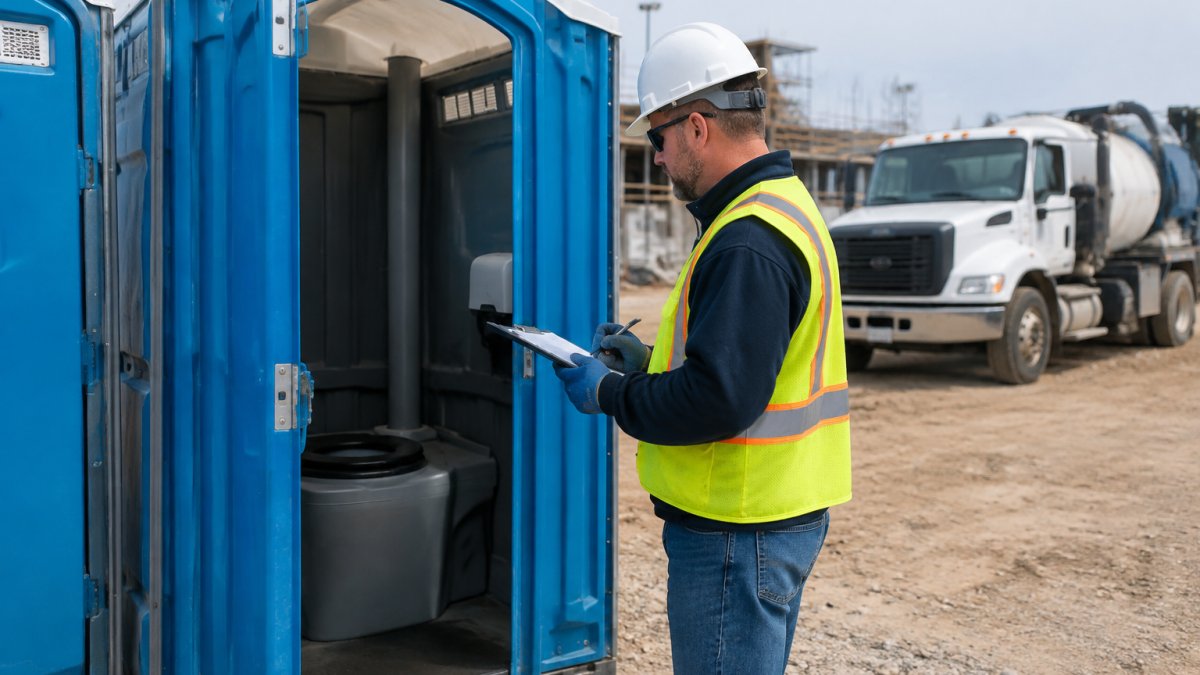
A portable restroom maintenance checklist is a written list of tasks a technician completes at every service visit, signed off so the site has a record. The checklist turns vague “it looked fine” into proof.
Daily Checks vs. Weekly Deep Service
Daily checks are quick visual passes by site staff. Weekly deep service is the full technician visit. Keep them separate so neither gets skipped.
- Confirm toilet paper and hand sanitizer are stocked
- Check the seat and floor for visible waste
- Confirm the door latch and lock work
- Note any odor at the door
- Log the unit number and time
Inspection and Damage Checks
Inspection catches small problems before they become repairs. Walk each unit and look for cracks, loose hinges, and a full or leaking waste tank. Check the vent and roof for damage. Flag anything that affects privacy or accessibility right away, including ADA-compliant units. Placement matters too, so pair your inspection with our construction site toilet placement tips.
How to Prevent Porta Potty Odors Before They Start
Odor control starts with the waste tank, not the air freshener. The fix is chemical dosing, proper venting, and frequent enough pump-outs. Masking a smell that comes from a full tank never works for long.
- Dose the tank with a deodorizer at every service, not just when it smells
- Keep the vent clear so gases escape
- Pump the waste tank before it is full
- Add service visits in hot weather
- Restock hand sanitizer so users are not spreading waste
Watch out: overfilling the tank is the fastest route to odor and mess. Set a pump-out trigger below full capacity and stick to it. A consistent deodorizer routine keeps freshness in check between visits.
Technician Safety, PPE, and Chemical Dosing Done Right
Technician safety is the part most maintenance guides skip. Service techs handle waste, chemicals, and confined spaces, so personal protective equipment is non-negotiable.
- Gloves and eye protection at every pump-out
- Boots and a high-visibility vest on active sites
- Handwashing after handling waste and chemicals
- Proper storage and mixing of deodorizers per label
- Never enter a unit or tank space without the right procedure
Chemical dosing deserves care. Use the dose the product label specifies, and log what you used.
Digital Records, Route Monitoring, and Troubleshooting Common Failures
Digital maintenance records can make service history easier to document for compliance purposes.
What a Useful Digital Record Contains
A useful service record generally captures the unit, date and time, tasks completed, supplies used, and any damage or defects noted.
Route Monitoring and Missed-Stop Prevention
Route monitoring works when the schedule is built from the service-frequency calculator above, not from a fixed calendar. Assign each unit a service interval and a pump-out trigger, then let the route tool flag any unit approaching either threshold. Missed-stop prevention comes from three habits: a daily route review before trucks roll, a same-day escalation when a stop is skipped, and a customer-facing confirmation after each visit.
Troubleshooting Common Failures: Decision Steps
Use these steps in order. Stop at the first step that resolves the symptom, and log what you did.
- Full tank too fast. Check per-unit daily users against the schedule. If users exceed the planning figure, add units or increase frequency before adjusting anything else. If users are within plan, check for a leaking tank or a pump-out trigger set too high.
- Persistent odor. Confirm the tank was pumped at the trigger, not after. Check the vent for blockage or damage. Verify the deodorizer dose matches the label ratio. Only after those three checks should you consider a different product.
- Clog or slow drain. Do not add chemicals blindly. Identify what was introduced (wipes, paper towels, foreign objects), remove the obstruction per the manufacturer’s procedure, and flag the unit if the clog recurs.
- Leak. Locate the source: tank seam, valve, or door seal. A leaking tank is a service failure, not a cleaning issue. Pull the unit from service and tag it for repair.
- Broken door or lock. Flag for repair immediately; do not wait for the next scheduled visit. A unit without a working lock fails privacy and accessibility expectations.
- Ventilation problem. Check the vent pipe and roof for damage or nesting. Poor ventilation shows up as odor that returns within hours of service.
- Frozen or heat-stressed unit. In freezing conditions, check tank chemistry and pump-out timing; in heat, add service visits and confirm the deodorizer is appropriate for the temperature.
For the official recordkeeping expectations behind sanitation compliance, the OSHA sanitation standard for general industry is the reference to keep on hand. Pair digital logs with a written cleaning checklist so nothing depends on memory.
Request a Maintenance Quote for Your Next Project
The best maintenance plan is the one that matches your site, your crew size, and your schedule. That is where we come in. Site Services USA offers nationwide coverage, fast delivery and pickup, same-day emergency service, and ADA-compliant portable sanitation.
Our services are designed to help projects stay on schedule and sites remain compliant. Contact Site Services USA to discuss a maintenance schedule for your site. Request a quote today.
Frequently Asked Questions
What is the OSHA rule for portable toilets on construction sites?
OSHA sets minimum toilet-to-worker ratios and sex-separation requirements for construction sites; confirm the current figures in the official standard. Units must be maintained in a sanitary condition and kept accessible. Falling short can trigger citations and fines, so verify your worker-to-toilet ratio before crews mobilize and adjust as headcount grows.
How often should a portable restroom be serviced?
Service frequency depends on crew size, tank capacity, and heat, so the right schedule varies by site. Service frequency depends on crew size, tank capacity, and heat. Build the schedule around usage, not a fixed calendar.
How do you keep a porta potty from smelling bad?
Odor control starts with correct chemical dosing and regular pump-outs, not air fresheners. Follow the deodorizer dose on the product label, avoid overfilling, and keep the vent pipe clear. Restocking hand sanitizer and keeping surfaces clean also help reduce odor.
When should a portable restroom be taken out of service?
Pull a unit from service if the tank is cracked, the door latch or lock fails, the roof is damaged, or the unit cannot be cleaned to a sanitary standard. Structural damage and missing privacy components are immediate disqualifiers. Tag the unit and report it to your provider. Continuing to use a damaged unit risks compliance issues and creates a hygiene hazard for workers.
A portable restroom is only as good as the service behind it. If your current schedule leaves units dirty, full, or out of supplies, it is time to change vendors. Site Services USA brings nationwide coverage, same-day emergency service, and ADA-compliant units to keep your site clean and compliant. Get started with Site Services USA and put your maintenance on a schedule you can prove.
