
Table of Contents
- Portable Toilet Rental for Construction Sites: What Your Quote Actually Covers
- How Many Porta Potties for a Construction Site: Sizing by Crew and Duration
- Standard, Deluxe, and Handicap-Accessible Units: Matching the Unit to the Job
- OSHA Construction Toilet Requirements: Compliance Without the Guesswork
- Construction Site Porta Potty Rental Cost: The Line Items That Move Your Price
- Construction Site Portable Toilet Service Frequency and Maintenance Planning
- Site Layout, Delivery, and Vendor Questions That Prevent Mid-Project Surprises
- Frequently Asked Questions
Last Updated: October 5, 2026
Portable Toilet Rental for Construction Sites: What Your Quote Actually Covers
Portable toilet rental for construction sites is the practice of placing, servicing, and removing self-contained restroom units on an active job site for the duration of a project. At Site Services USA, we handle this daily, and the pattern is always the same: the number on the quote is rarely the number crews care about. What matters is what sits under that number.
A rental quote bundles three separate things: the units themselves, the delivery and pickup, and the recurring service visits that keep each unit usable. Most disputes we see start when a crew assumes servicing is included and the invoice says otherwise. Below, we break down every line item so you can compare quotes on equal footing.
A portable restroom quote has three cost centers: equipment, logistics, and servicing. Ask which of the three is bundled before you compare totals.
How Many Porta Potties for a Construction Site: Sizing by Crew and Duration
The working rule is one standard unit per 10 workers on a 40-hour week. That ratio comes from OSHA’s sanitation standard for construction, OSHA 1926.51 requirements for potable water and sanitation, and it is the number inspectors check first. But the ratio is a floor, not a plan.
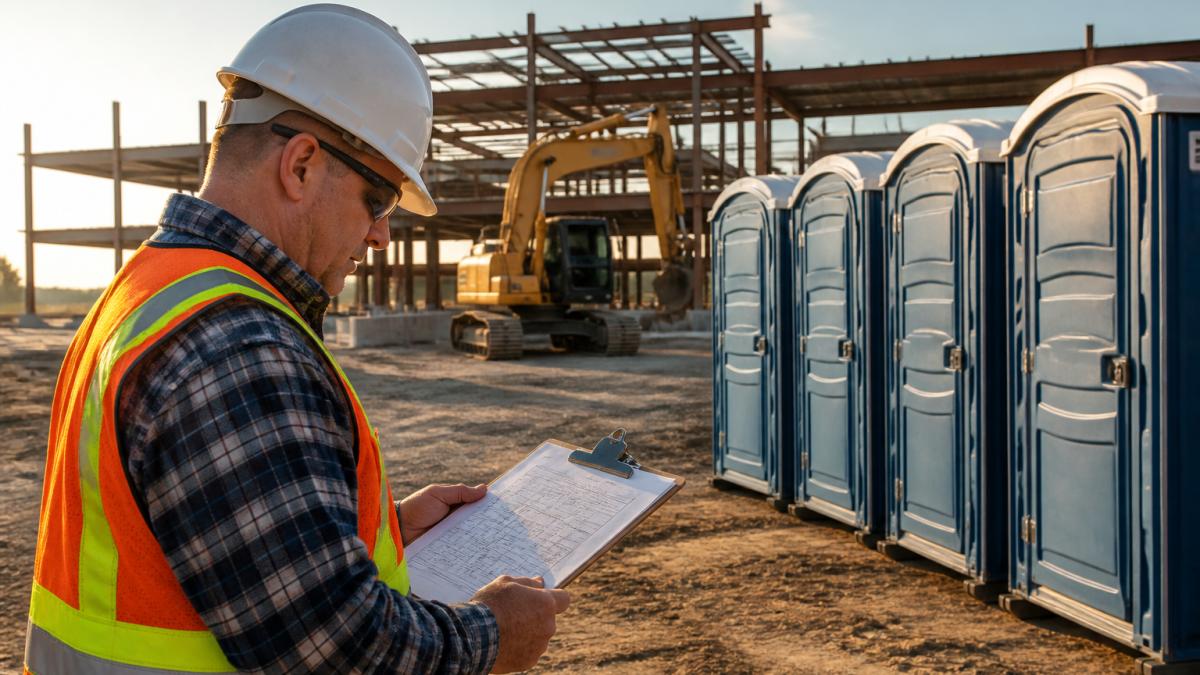
Start with peak headcount, not average. If 18 workers are on site Monday and 34 on Thursday when the concrete crew arrives, size for 34.
Use this planning table as a starting point, then adjust for your site:
| Peak workers on site | Standard units (40-hr week) | Standard units (50+ hr week) | Notes |
|---|---|---|---|
| 1-10 | 1 | 1-2 | Add a second unit if the site is spread out |
| 11-20 | 2 | 3 | Add one accessible unit per cluster |
| 21-30 | 3 | 4 | Plan for twice-weekly servicing |
| 31-40 | 4 | 5-6 | Consider a deluxe unit near the site trailer |
| 41-50 | 5 | 6-7 | Split into two clusters to cut walking distance |
| 51+ | 6 + 1 per additional 10 | 7 + 1 per additional 10 | Reassess servicing frequency monthly |
Two adjustments change the math:
- Crews over 20: add a unit for every additional 10 workers, and round up rather than down. A crew of 26 gets three units, not two and a half.
- Projects running past 40 hours a week: overtime stretches the same units further. A 60-hour week means roughly 50% more usage per unit, so add capacity before crews complain or the tanks fill mid-week.
- Mixed crews or multiple trades on site at once: size for the peak headcount, not the average, and consider separate clusters for trades working on opposite ends of the site.
- Multi-shift sites: each shift is effectively a separate population. Two 12-hour shifts of 15 workers each need capacity closer to a 30-worker single-shift site than a 15-worker one.
Duration matters as much as headcount. A two-week mobilization needs a different unit count than a nine-month build, because servicing frequency drives how many units a crew actually cycles through in a day.
A quick way to sanity-check your number: divide total weekly worker-hours by 400. That gives a rough unit count for a standard 40-hour week, and it scales cleanly when you add overtime or a second shift.
Write the peak headcount and shift structure into the rental agreement at mobilization. If the site adds a trade mid-project, you can scale unit count without renegotiating the whole contract.
Standard, Deluxe, and Handicap-Accessible Units: Matching the Unit to the Job
Standard units are the default for general construction. They are compact, single-occupancy, and built for high-traffic use by crews who need a fast stop and nothing more.
Deluxe units add a foot-pump sink, a mirror, and more interior space. They cost more per week and are usually reserved for site offices, client walkthroughs, or long-duration projects where crew comfort affects retention.
Handicap-accessible units meet ADA dimensions and are required once a site has employees or visitors who need them. A common mistake is ordering accessible units only for the site trailer. Place at least one near the main work zone so it is genuinely usable, not a walk across the site.
| Unit Type | Typical Use | Key Feature |
|---|---|---|
| Standard | General construction crews | Single occupancy, no sink |
| Deluxe | Site offices, long builds | Foot-pump sink, more space |
| Handicap-accessible | ADA compliance, visitor areas | Wider door, grab bars, level entry |
Order one accessible unit per restroom cluster rather than one per site. It keeps travel distance short and satisfies compliance without over-ordering.
OSHA Construction Toilet Requirements: Compliance Without the Guesswork
OSHA requires employers to provide accessible sanitary facilities for every construction crew, with separate facilities or a written policy where both sexes are present. The one-per-10-workers ratio is the practical benchmark most inspectors apply, and it is the number to plan around.
The compliance trap is not the ratio itself. It is the gap between the ratio and reality: units that are out of service, blocked by equipment, or too far from the work zone do not count in practice, even if they exist on paper. If a crew of 30 has three units but one is broken and one sits behind a locked gate, the site is effectively short.
Keep a simple log of unit count, service dates, and any units out of service. When an inspector asks, that log answers the question faster than a walk across the site.
Construction Site Porta Potty Rental Cost: The Line Items That Move Your Price
Construction site porta potty rental cost is driven by four variables, not one: unit type, rental length, service frequency, and delivery distance. Pricing depends on quantity, dates, and delivery, so we quote each project individually rather than publish a flat rate. What we can do is show you how a quote is built, so you can compare two bids line by line instead of staring at two totals.
A typical construction quote breaks into six line items:
| Line item | What it covers | How it is usually billed |
|---|---|---|
| Unit rental | The unit itself, per unit per week or month | Recurring, based on term |
| Delivery | Truck, driver, and drop-off at the site | One-time, per trip |
| Pickup | Removal at project end | One-time, per trip |
| Servicing | Pumping, deodorizer, paper restock, wipe-down | Per visit, per unit |
| Add-ons | Handwash stations, hand sanitizer, deluxe or accessible units | Per unit, per term |
| Fees | After-hours delivery, relocation, damage, cleaning outside normal wear | As incurred |
Here is how each one moves your total:
- Unit mix: standard units cost less per week than deluxe or accessible units. Accessible units carry a premium because of the wider footprint and additional hardware.
- Rental term: weekly rates apply to short mobilizations; monthly rental pricing lowers the per-week cost on longer builds. A three-month build billed monthly is usually cheaper per week than the same build billed weekly.
- Service frequency: weekly servicing is standard; twice-weekly or daily servicing on a large crew raises the total. On a 40-worker site, the servicing line can approach the unit rental line over a long project.
- Delivery and pickup: distance from the local service yard, plus any site access restrictions, affects logistics cost. A site with a narrow gate or soft ground that requires a smaller truck may cost more to service.
- Add-ons: handwash stations, sanitizer stands, and step-and-pump sinks are separate line items on most quotes. Confirm whether they are included or billed per unit.
- Extra charges: after-hours delivery, relocation mid-project, and damage or cleaning fees outside normal wear. These are the line items that turn a clean quote into a disputed invoice.
A practical way to compare two bids: ask each vendor to quote the same unit count, the same service frequency, and the same rental term, then compare the six line items side by side. If one total is dramatically lower, the difference is almost always in servicing frequency or in what counts as an add-on.
The most common surprise on a final invoice is a mid-project relocation fee. If your site plan changes and units need to move, confirm in writing whether that is included or billed separately. The second most common is a servicing frequency that was quoted as ‘as needed’ rather than a fixed schedule.
Compare quotes on the six line items, not the total. Unit rental, delivery, pickup, servicing, add-ons, and fees are the only places a quote can hide a difference.
Construction Site Portable Toilet Service Frequency and Maintenance Planning
Weekly servicing is the baseline for a standard construction site. Each visit pumps the waste tank, refreshes the deodorizer, restocks paper, and wipes down high-touch surfaces. High-traffic sites, hot weather, and crews over 30 workers often need twice-weekly visits.
Build the service schedule into your project timeline, not around it. A missed visit on a Friday means a full tank all weekend, and that is when crews start using the treeline instead. Book recurring visits at mobilization so the schedule runs automatically for the life of the project.
For long-term rental, plan a mid-project deep clean every few months. It costs less than replacing a unit that has been abused, and it keeps the site inspection-ready.
Site Layout, Delivery, and Vendor Questions That Prevent Mid-Project Surprises
Placement decides whether a unit gets used or ignored. Put restrooms within a short walk of the main work zone, on level ground, with a clear path for the service truck. A unit the pump truck cannot reach is a unit that will not get serviced.
Before you sign, get answers to these in writing:
- Is servicing included in the quoted rate, and how often?
- What is the delivery window, and is after-hours drop-off available?
- Who handles relocation if the site plan changes?
- What is the response time for a same-day emergency call?
- Are there damage or cleaning fees outside normal wear?
- Can the provider scale unit count mid-project without a new contract?
A vendor that answers all six without hedging is a vendor that will not surprise you in month three. Site Services USA handles nationwide delivery, same-day emergency service, and ADA-compliant portable sanitation.
Frequently Asked Questions
How much does it cost to rent a porta-potty for one week?
Weekly rates vary by unit type, quantity, project duration, and delivery distance, so there is no single figure that applies everywhere. A standard unit on a short-term rental usually costs less per week than a deluxe or ADA-compliant unit, and long-term rentals typically bring the weekly rate down. Ask for an itemized quote that separates the weekly rate from delivery, pickup, and servicing so you can compare providers on equal terms.
What does OSHA say about portable toilets on construction sites?
OSHA’s sanitation standard for construction (29 CFR 1926.51) requires employers to provide toilet facilities at the site and to keep them in sanitary condition. The rule does not set a fixed number of units in the regulation itself; a common industry benchmark is one toilet per 10 workers, with separate facilities where required. Because OSHA can cite employers for unsanitary or insufficient facilities, confirm your unit count and service schedule before crews mobilize.
How many portable toilets does a construction site need?
Start with the one-per-10-workers benchmark, then adjust for shift length, site size, and whether women are on the crew. A 40-person crew points to at least two units; a 100-person crew points to five or more. Add a handicap-accessible unit for accessibility and a handwashing station where the work involves chemicals, concrete, or food handling. When in doubt, order one extra rather than risk an OSHA citation or crew complaints.
How often should portable toilets be serviced on a construction site?
Weekly servicing is the baseline for a standard unit on a typical construction site. High-traffic sites, summer heat, and large crews may need twice-weekly or even daily service. Each service visit should include pumping the waste tank, recharging the deodorizer, restocking toilet paper, and wiping down surfaces. Put the service schedule in the rental contract and ask the provider to log each visit so you have documentation if compliance questions come up.
Construction schedules do not wait for a restroom vendor that misses a pickup. Site Services USA keeps projects on schedule with fast, reliable delivery and pickup, same-day emergency service, and ADA-compliant portable sanitation across every market we serve. Get started with Site Services USA and lock in a portable toilet rental plan before your next mobilization.