
Table of Contents
- When Emergency Same Day Portable Toilet Delivery Saves Your Project
- Same-Day Portable Toilet Rental: How to Order Fast
- Portable Toilet Delivery for Construction Sites: Meeting OSHA and Keeping Crews Working
- ADA-Compliant Portable Toilet Rental for Emergencies
- Portable Restroom Service Frequency: What to Expect After Delivery
- Delivery Timelines, Site Access, and Placement Requirements
- Pricing and Surcharges: What Drives the Cost of Emergency Rental
- Conclusion
- Frequently Asked Questions
Last Updated: October 18, 2026
When Emergency Same Day Portable Toilet Delivery Saves Your Project
Emergency same day portable toilet delivery places a portable restroom on your site within hours of your call, not days.
The situations that trigger a same-day order tend to fall into four buckets:
- A construction crew scaled up overnight. A subcontractor added bodies to the site and the existing unit count no longer covers the crew.
- An event outgrew its plan. Ticket sales beat projections, or a vendor cancelled and left a gap in the restroom line.
- A unit failed. Vandalism, wind damage, or a full tank with no service scheduled takes a unit out of commission.
None are planning failures, they are timing problems, and same-day service solves timing.
Do not wait until the morning of your event or the first day of a crew mobilization to call. Same-day availability depends on local inventory, and inventory in your area may already be committed. Call as soon as you know you have a gap.
Same-Day Portable Toilet Rental: How to Order Fast
Ordering a same-day portable toilet rental comes down to one call with four things ready: delivery address, worker or attendee count, hours needed, and access constraints. Give a dispatcher those and the quote takes minutes.
Here is how to run the call:
- State that it is a same-day order. Say the words “same day” in your first sentence. Dispatchers triage calls, and an urgent order gets routed differently than a quote request for next month.
- Give the exact delivery location. Not the office address. The gate, the lot, the field entrance. Include cross streets if the site is hard to find.
- Describe site access. Is there a paved road to the placement spot? Any low branches, soft ground, locked gates, or steep grades? A truck and trailer need room to turn around.
- Confirm the rental period. One day, a weekend, a week. This affects both availability and price.
- Ask for the delivery window in writing. Get a time range, not a promise of “sometime today.”
What to Have Ready Before You Call
Keep this checklist handy. It turns a five-minute scramble into a two-minute call.
- Full delivery address plus gate or entrance instructions
- Contact name and mobile number for the person on site
- Worker count or attendee estimate
Send the site address as a map pin in a text message before the call ends. Drivers lose more time hunting for unmarked job sites than they do on the road, and a pin removes that delay entirely.
How to Verify a Same-Day Promise Before You Commit
A same-day promise is only as good as the inventory behind it. Before you hang up, confirm three things in writing:
- Inventory confirmation. Ask the dispatcher to confirm a specific unit is allocated to your order, not just that the company “has units in the area.” A verbal yes is not allocation.
- A committed delivery window. Get a start and end time, plus a name and direct number for the driver or dispatch desk. “Morning” is not a window.
- A fallback plan. Ask what happens if the truck is delayed or the unit cannot be placed. A provider with a real same-day operation will have a backup unit or a revised ETA, not silence.
Often the first provider called cannot deliver same day because local stock is committed to scheduled accounts. Ask each next provider whether they have an accessible unit and can deliver before your hard deadline.
What to Do If No Provider Can Deliver Same Day
When same-day delivery is not possible, secure the earliest committed window and bridge the gap:
- Accept a next-morning delivery and rent a handwashing station or temporary privacy screen for the interim. It is not a restroom, but it keeps a small crew functional for a few hours.
- Ask about a transfer from a nearby scheduled account. Some providers can pull a unit from a low-use account and reposition it, which is faster than waiting on a new delivery from a distant depot.
- Confirm the pickup schedule at the same time as the delivery. A unit that arrives same day but is not scheduled for pickup creates a new problem at the end of the rental.
Portable Toilet Delivery for Construction Sites: Meeting OSHA and Keeping Crews Working
Portable toilet delivery for construction sites has a compliance dimension that event rentals do not. The OSHA sanitation standard for construction requires employers to provide sanitary toilet facilities at the worksite, and the widely used planning rule is one toilet per ten workers.
The real cost of a sanitation gap is not the rental fee, it is the crew standing around while someone drives to a hardware store or waits on a delivery.
A few practical points for contractors:
- Count the total bodies on site, including subcontractors and inspectors, not just your own payroll.
- Separate male and female workers when the crew size makes it practical, and plan for at least one accessible unit once the site is large enough.
- Place units within reasonable walking distance of the work area. A restroom at the far gate will not get used, and that creates a different set of problems.
For crews scaling up fast, the fastest path is often adding units to an existing service plan rather than starting a new account. Ask when you call.
ADA-Compliant Portable Toilet Rental for Emergencies
ADA-compliant portable toilet rental matters most in the situations that trigger emergency orders: public events, disaster response sites, and any job with public access.
The practical rule is to include at least one accessible unit in any restroom line that serves the public, and to place it on firm, level ground at the end of the row where it is easiest to reach.
Accessible units are the first to run out during a regional emergency: when a storm puts multiple sites into response mode, standard units get pulled quickly and accessible stock goes with them.
Portable Restroom Service Frequency: What to Expect After Delivery
Portable restroom service frequency depends on usage. The baseline is one service visit per week per unit for a normal crew, and more often for high-traffic events or large crews.
Service means pumping the tank, recharging the deodorizer, and wiping down the interior. Skipping a visit shows up fast as odor, a rising fill level, and crew complaints.
Match service frequency to usage from day one. A unit serving ten workers and a unit serving a festival crowd need completely different schedules, and the emergency order is the moment to set that expectation rather than discover it three days in.
Delivery Timelines, Site Access, and Placement Requirements
Delivery timelines depend on local inventory, distance from the nearest depot, and how ready your site is when the truck arrives.
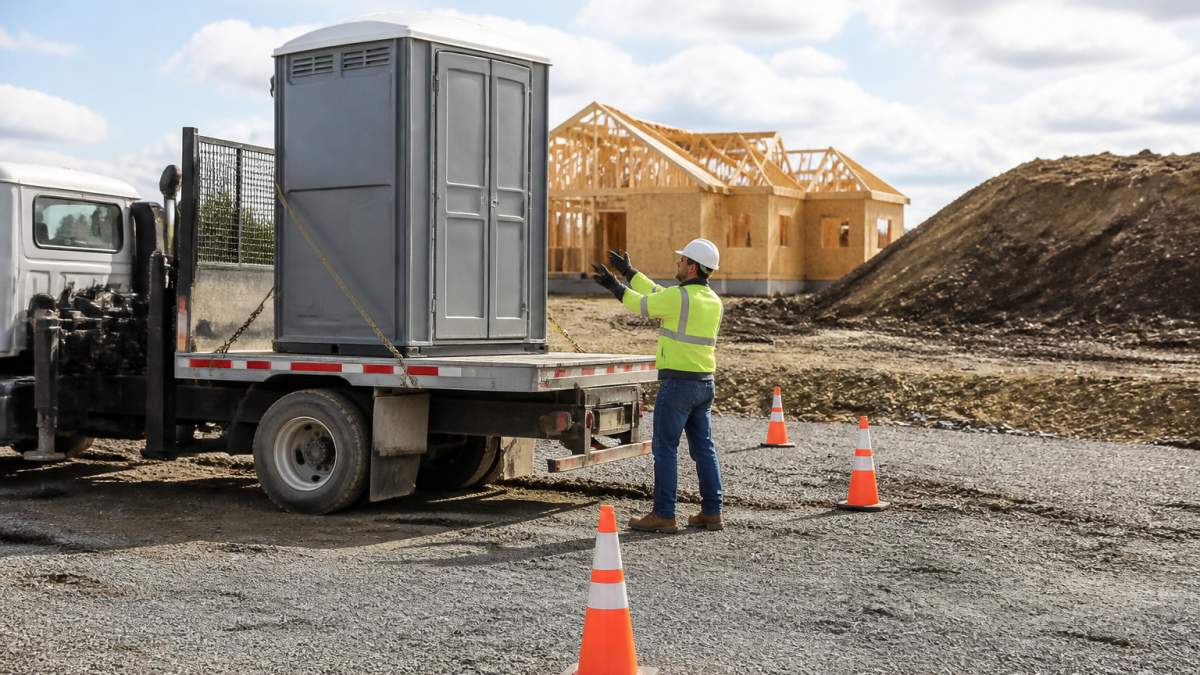
Site access is where most delays happen, and almost all of them are preventable:
- Clear a path. The truck needs a route wide enough and firm enough to reach the placement spot.
- Choose level ground. A unit on a slope is unstable and unsafe. Firm, flat, well-drained ground is the requirement.
- Keep clearance overhead. Low branches and power lines block a tall unit on a trailer.
Placing a unit on soft ground after rain is a common same-day failure. The truck sinks, the delivery is delayed, and the unit may need to be repositioned. Check the surface before the driver arrives, not after.
Pricing and Surcharges: What Drives the Cost of Emergency Rental
Pricing for an emergency rental depends on quantity, dates, delivery distance, and urgency. Quotes are provided individually, as a single unit across town and a ten-unit order across a region are not the same job.
The line items that drive the total are worth understanding before you compare quotes:
| Cost Driver | What It Covers | How to Manage It |
|---|---|---|
| Base rental | Unit use for the rental period | Match the period to the job, not to habit |
| Delivery fee | Truck and driver to your site | Consolidate units into one delivery |
| Pickup fee | Removal at the end of the term | Confirm the pickup date when booking |
| Same-day premium | Expedited dispatch and routing | Order early in the day when possible |
| Service visits | Pumping and restocking | Set frequency to actual usage |
| After-hours delivery | Dispatch outside business hours | Schedule daytime delivery if the site allows |
| Extended rental | Units kept past the agreed term | Set a firm end date and track it |
How to Read an Itemized Emergency Quote
A quote that looks low on the base rate can climb once delivery, pickup, service, and urgent-order fees appear. Ask for it broken into these lines and compare line by line:
- Base rental per unit, per period. Confirm whether the period is daily, weekly, or monthly, and whether the rate changes for a weekend or holiday.
- Delivery and pickup, itemized separately. Some providers bundle these; ask for the split so you can see what a second delivery would cost if you add units later.
- Same-day or expedited fee. This is the premium for dispatch and routing outside the normal schedule. Ask whether it is a flat fee or a percentage of the base rental.
- Servicing frequency and per-visit cost. Confirm how many visits are included and what an extra visit costs if usage runs high.
- After-hours or weekend dispatch. If your delivery window falls outside business hours, ask whether the fee applies to delivery, pickup, or both.
- Taxes and any permit or placement fees. These vary by jurisdiction and are sometimes passed through separately.
- Damage or cleaning deposit. Ask whether it is refundable and what conditions trigger a charge.
The FTC guidance on advertising and pricing is clear that quoted prices should reflect what the customer actually pays, so ask any provider to itemize delivery, pickup, and service charges before you commit. A quote that looks low on the base rate can climb once those line items appear.
Questions That Expose Hidden Fees
Ask these before you sign or pay a deposit to make two quotes comparable:
- “What is the total I will owe if the unit stays exactly as long as I described, including delivery, pickup, service, and taxes?”
- “Is the same-day fee a flat charge or a percentage, and does it apply to pickup as well as delivery?”
- “How many service visits are included, and what does an extra visit cost?”
Ask one question on every quote: “What is the total I will owe if the unit stays exactly as long as I described?” That single number makes two quotes comparable and exposes hidden fees immediately.
In urgent orders the same-day premium and after-hours fee often stack, and neither appears in the headline rate. Get both quoted in writing before dispatch.
Conclusion
The hardest part of an emergency sanitation order is not the delivery. It is the hour you spend calling around while your crew stands idle. Site Services USA handles same-day emergency service nationwide, with fast delivery and pickup, ADA-compliant units, and competitive pricing. Request a quote from Site Services USA to address your portable sanitation needs efficiently.
Frequently Asked Questions
Can I get a portable toilet delivered the same day?
Yes, same-day portable toilet delivery is available in many areas when you call early and the provider has inventory nearby. Availability depends on your location, the number of units needed, and site access. To secure same-day service, have your delivery address, site contact, and unit quantity ready. Expect a same-day premium and confirm the delivery window and any after-hours fees before booking.
How quickly can an emergency portable toilet be delivered?
Emergency portable toilet delivery often happens within hours, but timing varies by distance, traffic, and inventory. Some providers offer rapid delivery for urgent needs, especially for disaster relief or construction sites. To speed things up, clear a path for the truck, mark the placement spot, and provide a phone number for the site contact. Always ask for a confirmed delivery window, not just a promise.
How many portable toilets do I need for a construction site?
OSHA recommends at least one toilet per 10 workers on a construction site. For a crew of 30, plan for three standard units, plus an ADA-compliant unit if required. Event planners should estimate based on attendee count and event duration. Underestimating leads to long lines and complaints. When in doubt, order extra units; it is cheaper than a mid-project emergency delivery.
Can I request an ADA-compliant portable toilet for same-day delivery?
Yes, ADA-compliant portable toilet rental can often be arranged for same-day delivery, but availability may be limited. These units are larger and require a flat, accessible route. Request the ADA unit when you place your emergency order and confirm the delivery window. If same-day ADA is not available, ask about a next-day delivery or a temporary alternative that meets accessibility needs.