
Table of Contents
- Portable Restroom Rental for Small Renovations: Quick Comparison
- Portable Restroom Rental Cost: What Drives the Price
- Portable Toilet Rental Duration: How Long Do You Need One?
- Portable Toilet Placement on Residential Property
- Portable Restroom Servicing Frequency During a Renovation
- How to Choose a Portable Restroom Rental Provider
- Frequently Asked Questions
Last Updated: October 16, 2026
Portable Restroom Rental for Small Renovations: Quick Comparison
Portable restroom rental for small renovations is the practice of placing a temporary toilet on a residential property so a crew has sanitation on site without using the homeowner’s bathroom. For a kitchen or bath remodel, that usually means one standard unit for the length of the messy phase.
The comparison below covers the unit types you’ll actually be offered, what each one suits, and the trade-offs that matter on a job this size.
| Unit Type | Typical Use | Key Advantage | Main Trade-Off |
|---|---|---|---|
| Standard unit | Most small remodels | Lowest cost, easy placement | No sink, basic interior |
| Flushable unit | Occupied homes, longer jobs | Fresher feel, less odor | Costs more, needs water access |
| Restroom trailer | High-end or multi-week work | Sinks, lighting, stalls | Needs power and a level pad |
| ADA-compliant unit | Projects with accessibility needs | Meets accessibility rules | Larger footprint, higher cost |
Quick Picks:
- Best overall for a small renovation: a single standard unit, serviced weekly
- Best when the family stays home: a flushable unit placed away from the living areas
- Best for a high-end remodel: a restroom trailer with running water and lighting
- Best if anyone on site needs step-free access: an ADA-compliant unit
Match the unit to the job, not to the brochure. Most small renovations need one standard unit for four to six weeks, nothing more.
Portable Restroom Rental Cost: What Drives the Price
Portable restroom rental cost comes down to four things: the unit type, the rental period, how often it’s serviced, and how far the truck has to travel. A standard unit for a two-week bathroom remodel sits at the low end.
Most providers route you to a quote form. That’s not a budget. Here’s how the numbers actually stack up for a small renovation, so you can sanity-check any quote you get.
Typical Price Ranges for a Small Renovation
These are the ranges most providers fall into for a residential job. Your address, dates, and access will move the number, but if a quote lands far outside these bands, ask why.
| Cost Component | Typical Range | What Moves It |
|---|---|---|
| Standard unit, weekly | $30-$75 per week | Region, provider size, contract length |
| Standard unit, monthly | $100-$200 per month | Same as above, plus service visits included |
| Delivery and pickup | $50-$150 each way | Distance from the yard, gate or stair access |
| Standard service visit | $30-$60 per visit | Tank size, whether supplies are restocked |
| Flushable unit, weekly | $100-$175 per week | Water access, tank capacity |
| Restroom trailer, weekly | $500-$1,500 per week | Stalls, sinks, climate control, generator needs |
| ADA-compliant unit, weekly | $75-$150 per week | Larger footprint, limited local inventory |
A realistic all-in number for a four-week kitchen remodel with one standard unit, weekly service, and a local delivery can vary. That’s the figure to hold in your head when you compare quotes.
A Worked Example: Four-Week Bathroom Remodel
Say you’re renovating one bathroom, the crew is three people, and the unit sits on your driveway for four weeks. Pricing will depend on the unit type, rental period, service frequency, and delivery distance. Now change one variable. The job slips to eight weeks. This will impact the overall cost, and it’s why the duration section below matters as much as the unit choice.
The Fees That Show Up After You Book
The gap between a quoted rate and a final invoice is almost always one of these:
- Extra service visits. If the crew grows or the weather turns hot, you may need twice-weekly pumping. Each visit adds to the cost.
- Second delivery trip. If the unit is pulled before the job finishes and you need it back, you pay delivery again.
- Fuel or distance surcharge. Remote addresses can add a surcharge per trip.
- Damage or tipping fee. A unit that’s been tipped or vandalized can carry a charge.
The most common budget surprise on a small renovation is an extra service visit or a second delivery trip. Ask what triggers each one, and get the answer in writing before the unit lands.
Fee Transparency: What to Ask Before You Book
Ask for the all-in number before you sign, not the headline rate. A provider that itemizes delivery, pickup, and service visits upfront is a provider you can budget around.
Run this checklist before you book:
- Is delivery and pickup included, or billed separately?
- How many service visits are in the quoted price, and what does an extra visit cost?
- Is there a fuel or distance surcharge for my address?
- What’s the fee if the unit is damaged or tipped?
If a provider won’t put those six answers in writing, treat the quote as a starting point, not a budget.
Portable Toilet Rental Duration: How Long Do You Need One?
Portable toilet rental duration should match the phase of work that actually needs it, not the full project calendar.
For a typical bathroom or kitchen remodel, plan on four to six weeks. For a larger renovation with multiple trades overlapping, two to three months is more realistic.
Three signals it’s time to extend:
- More than one trade is working the same week
- The project has slipped past its original finish date
- The crew size has grown since the unit was ordered
Extending a rental is almost always cheaper than a same-week re-delivery. Call before the scheduled pickup date, not after.
Portable Toilet Placement on Residential Property
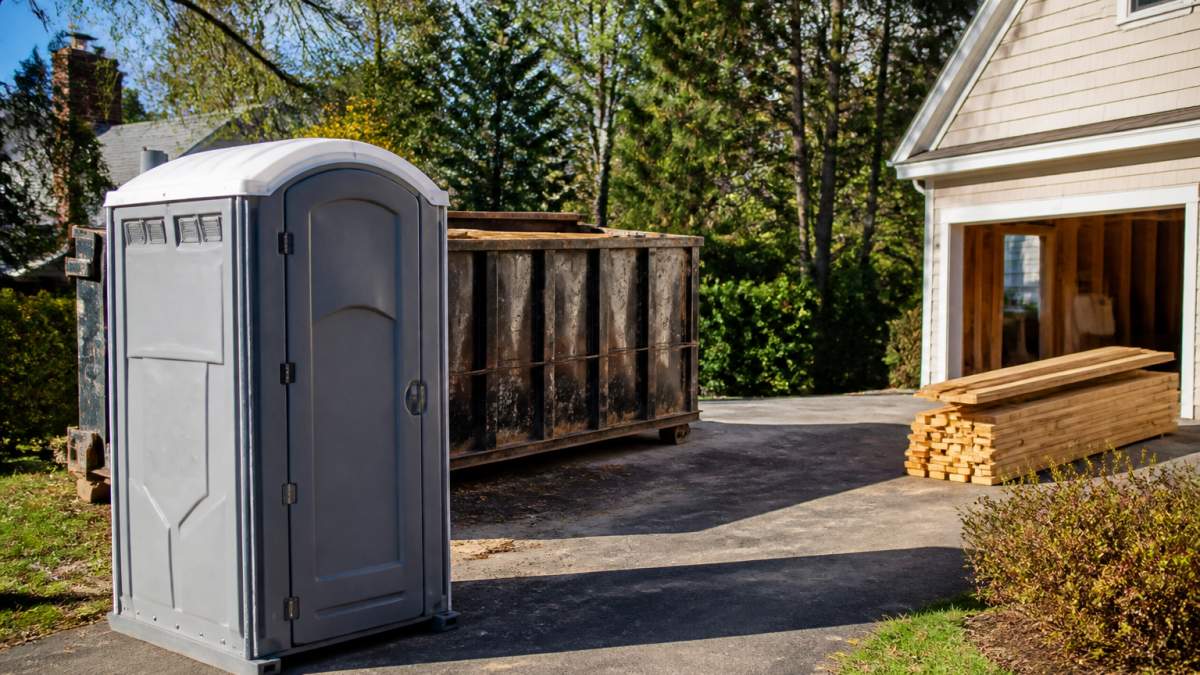
Portable toilet placement on residential property is where most small renovations run into trouble, because the spot that’s convenient for the crew is often the spot the homeowner hates.
The Space a Unit Actually Needs
A standard unit is roughly 4 feet wide by 4 feet deep by 7 feet tall. Add clearance for the door swing and for a person to stand outside it, and you’re reserving a pad about 5 feet by 5 feet.
The service truck needs a clear path to within roughly 30 feet of the unit, because that’s the practical limit for most vacuum hoses.
Driveway, Side Yard, or Street: Access and Constraints
The driveway is the default choice for good reason. It’s flat, close to the work, and the service truck can reach it without a long hose run.
A side yard works when the driveway is needed for materials, but check the path first.
Street placement is the last resort. In many municipalities it requires a right-of-way permit, and it puts the unit where it can be hit, ticketed, or complained about.
Utility Clearances and What Not to Block
Before you commit to a spot, walk the pad and check for:
- Water and gas meters. Keep the unit clear of the meter so a utility reader can still access it.
- HVAC condensers and dryer vents. A unit parked against a condenser blocks airflow and can shorten the equipment’s life.
- Electrical panels and exterior outlets. Don’t block a panel a contractor may need to open.
- Septic tanks and drain fields. A loaded unit on top of a drain field can crack a line. If you don’t know where your tank is, find out first.
Protecting Landscaping and Hardscape
A full standard unit weighs several hundred pounds once the tank has waste in it. On a driveway, that’s fine. On grass, it will leave ruts, and in summer it can kill the turf underneath.
A few practical moves:
- Put down a sheet of plywood or a rubber mat under the unit to spread the load.
- Keep the unit off newly laid sod and off mulch beds that will stain.
- Route the service hose so it doesn’t drag across flower beds.
- If the unit sits on pavers, check for settling after the first service visit.
HOA Rules, Permits, and Neighbors
If you live under a homeowners association, check the covenants before the unit arrives. Many HOAs restrict temporary structures, and some require written approval.
If street placement is your only option, confirm whether your municipality requires a permit and how long it takes to issue one.
One more thing most guides skip: tell the neighbors. A unit that appears without warning on a shared driveway causes more complaints than the noise ever does.
Walk the placement with your contractor before you book. The crew knows where they’ll be working, and you know where the family parks, plays, and walks. The right spot is the one both of you agree on before the truck shows up.
Portable Restroom Servicing Frequency During a Renovation
Portable restroom servicing frequency during a renovation is once per week for a standard unit under normal use. That visit pumps the tank, refills the fresh water and deodorizer, and restocks supplies.
Three situations call for more frequent service:
- More than ten workers on site. OSHA guidance ties sanitation requirements to crew size, so a bigger crew means more capacity and more visits.
- Hot weather. Heat accelerates odor and tank fill.
- Flushable units and trailers. These hold more but still need regular pumping.
If you’re unsure what your job needs, ask the provider to recommend a schedule based on crew size and duration. A good provider will tell you when once a week isn’t enough rather than wait for a complaint.
How to Choose a Portable Restroom Rental Provider
Choose a provider on four criteria: delivery reliability, service schedule, unit condition, and how clearly they quote. Price matters, but a cheap unit that arrives late or isn’t serviced costs more in delays than it saves.
What to check before you commit:
- Delivery window. Can they commit to a day, or just a week?
- Servicing. Is the schedule fixed, or does it depend on when a truck is nearby?
- Unit condition. Ask when the unit was last serviced and whether it’s cleaned between rentals.
- Accessibility. If anyone on site needs step-free access, confirm an ADA-compliant unit is available.
We deliver portable toilets, dumpsters, temporary fencing, and storage containers from one vendor, with same-day emergency service when a unit fails or a project changes.
Frequently Asked Questions
Do I need a portable restroom for a small home renovation?
For any renovation lasting more than a day or two with workers on site, yes. Without a working bathroom, crews lose time leaving the property to find facilities. A standard portable restroom rental keeps the job moving and satisfies basic sanitation expectations. If the home’s bathroom stays usable, you may not need one, but most renovations involve at least some period where plumbing is disconnected.
How much does a portable restroom rental cost for a renovation?
Portable restroom rental cost depends on unit type, rental length, delivery distance, and servicing frequency. Standard units typically cost less than flushable or ADA-compliant models, and weekly rates can be more economical than daily rates for longer projects. Delivery and pickup fees vary by provider. Request a quote from Site Services USA with your project dates and address to get exact pricing for your renovation.
How long should I rent a portable restroom for a home renovation?
Match the portable toilet rental duration to your project timeline. A bathroom remodel might need a unit for two to four weeks, while a larger renovation could run two to three months. Providers typically offer daily, weekly, and monthly rates, with monthly pricing saving money on longer jobs. Schedule delivery for the day work begins and pickup for the day after final cleanup.
Where should a portable restroom be placed on a residential property?
Place the unit on firm, level ground within reach of the delivery truck, usually the driveway or a side yard. Keep it at least 10 feet from the house if local codes require it, and avoid blocking sidewalks or neighbors’ access. Portable toilet placement on residential property should also consider wind exposure and distance from where workers are active. Confirm the spot with your provider before delivery day.
How often should a portable restroom be serviced during a renovation?
For a small crew of two to five workers, weekly servicing is standard. Portable restroom servicing frequency should increase to twice weekly if more workers are on site or if the unit gets heavy use during hot weather. Servicing includes pumping waste, refreshing deodorizer, and restocking supplies. Ask your provider about their default schedule and whether you can adjust it mid-project.
A small renovation still needs working sanitation, and getting it wrong means delays, complaints, or a crew using the homeowner’s bathroom. Site Services USA handles portable restroom rental nationwide, with fast delivery and pickup, ADA-compliant units, and same-day emergency service when plans change. Request a quote and we’ll match the unit and service schedule to your project.