
Last Updated: October 26, 2026
Quick Summary
An ada compliant portable toilet rental comes in three main formats: stand-alone accessible units for construction sites and small crews, grouped accessible units for festivals and weddings, and accessible restroom trailers for premium multi-day events. At least 5% of a portable toilet setup should be ADA-compliant, and accessible units cost more because they are larger.
- Stand-alone accessible units suit construction sites, utility job sites, and small venues needing one compliant unit.
- Accessible units must include a turning circle typically 60 inches in diameter, reinforced grab bars, and a wide door.
- Place at least one accessible unit in every restroom zone so users never cross the whole site.
- Ask providers to break quotes into rental, delivery, pickup, servicing, and site-prep charges.
- Keep a clear path at least 60 inches wide leading to each accessible unit door.
Table of Contents
- Quick Comparison of ADA Compliant Portable Toilet Rental Options
- What ADA Portable Restroom Requirements Actually Require
- Option 1: Stand-Alone ADA Compliant Portable Toilet Units
- Option 2: Accessible Portable Toilets for Events and High-Traffic Venues
- Option 3: Accessible Restroom Trailer Rental for Premium Accommodation
- Portable Toilet Rental Cost: What Drives the Price of an Accessible Unit
- How Many Accessible Units You Need and Where to Place Them
- Requesting an ADA Compliant Portable Toilet Rental Quote
- Frequently Asked Questions
Quick Comparison of ADA Compliant Portable Toilet Rental Options
Finding ada compliant portable toilet rental options starts with knowing what each format delivers. Event planners and site managers often ask about wheelchair access without overpaying for capacity they will never use.
The table below summarizes the formats we see requested most.
| Rental Option | Typical Format | Best For | Access Features | Pricing Model |
|---|---|---|---|---|
| Stand-alone ADA unit | Single accessible toilet | Construction sites, small crews | Ramp, grab bars, wide door | Daily, weekly, monthly |
| Event accessible units | Single accessible toilet, grouped | Festivals, weddings, high-traffic venues | Ramp or no-ramp access, reinforced grab bars | Per event, per unit |
| Accessible restroom trailer | Multi-station trailer | Premium events, multi-day gatherings | Ramped entry, spacious interior, running water | Daily, plus delivery and service |
One planning benchmark worth knowing: at least 5% of a portable toilet setup should be ADA-compliant, a figure National Porta Potty Rentals cites in its accessible unit guidance.
What ADA Portable Restroom Requirements Actually Require
ADA portable restroom requirements focus on three things: enough floor space to turn a wheelchair, grab bars that support transfer, and an entrance a wheelchair can enter without assistance. The 2010 ADA Standards for Accessible Design set the dimensions that compliant units are built to meet.
A genuinely accessible unit is not a standard portable toilet with a wider door bolted on. The interior must let a wheelchair user enter, close the door, turn around, and transfer to the seat, which is why accessible units are larger and cost more.
Maneuvering Space, Grab Bars and Ramp Specs That Get Checked
The specs that matter most in practice are the ones a provider should confirm in writing before delivery:
- Maneuvering space: a clear turning circle inside the unit, typically 60 inches in diameter, so a wheelchair can rotate
- Grab bars: reinforced bars mounted beside the seat, strong enough to bear a user’s weight during transfer
- Door width: a wide opening that clears a wheelchair, not just a walker
Watch out: a provider who lists “ADA” without stating unit dimensions or grab bar specs is asking you to take it on faith. Ask for the measurements.
Option 1: Stand-Alone ADA Compliant Portable Toilet Units
A stand-alone ADA compliant portable toilet is the workhorse of accessible sanitation: a single accessible unit, delivered and serviced on its own, suited to construction sites, small crews, and any job needing compliant access without a trailer.
For construction managers, the appeal is scheduling: a stand-alone unit can be dropped on a firm pad near the crew, serviced on a routine cycle, and swapped out if it fails. You can order portable toilets for construction sites with accessible units in the same delivery.
Best for: construction crews, utility and telecom job sites, and small venues that need one accessible unit.
Skip if: you are hosting a multi-day event with hundreds of guests, where a trailer or a grouped setup makes more sense.
Option 2: Accessible Portable Toilets for Events and High-Traffic Venues
Accessible portable toilets for events solve a different problem: volume.
The 5% benchmark is a floor, not a ceiling. For weddings, festivals, and corporate events, you can book portable toilet rental for events with accessible units built into the plan from the start.
Best for: festivals, weddings, corporate events, and any venue with a mixed crowd.
Skip if: your guest count is small and a single stand-alone unit covers the need.
Option 3: Accessible Restroom Trailer Rental for Premium Accommodation
Accessible restroom trailer rental is the premium tier: multiple stations, running water, lighting, and a ramped entry, making it the right call for multi-day events, VIP areas, and venues where guests expect a restroom that feels like a building.
Trailers carry higher delivery and servicing costs than single units, because the tow vehicle, setup, and pump-out are all part of the job.
Best for: multi-day events, VIP and hospitality areas, and venues with running water needs.
Skip if: you need a single accessible unit on a job site or a tight budget.
Portable Toilet Rental Cost: What Drives the Price of an Accessible Unit
Accessible units cost more than standard units for structural reasons: a larger molded shell, a reinforced frame to carry grab-bar loads, a ramp or flush-entry design, and more interior finishing all add material and labor.
A common pattern in the industry is that the rental rate itself is only part of the invoice. The line items that move the total most are:
- Rental duration: daily, weekly, and monthly rates are not proportional. A weekly rate is typically well below seven daily rates, and a monthly rate is well below four weekly rates. If your project runs longer than a few days, ask for the weekly and monthly tiers explicitly rather than accepting a daily rate multiplied out.
- Delivery and pickup distance: transport is a real cost, quoted per trip. Remote sites, congested venues with limited delivery windows, and locations requiring a smaller shuttle vehicle all raise this line. Ask whether the quote is per unit or per trip, and whether a return trip for pickup is included.
- Servicing frequency: standard service is typically weekly, and it includes pumping the holding tank, restocking consumables, and wiping down surfaces. High-traffic events often need daily or mid-event service, which is billed per service visit. For a multi-day festival, servicing can rival the rental rate itself.
Ask whether delivery, pickup, servicing, and any site-prep charges are included in the quoted rate. A low headline rental price with delivery and pickup billed separately is the most common way a final invoice climbs well above the estimate.
Separate rental pricing from purchase pricing. Buying an accessible unit is a capital purchase with its own delivery, setup, and long-term servicing obligations, and it only makes sense for organizations needing accessible sanitation on an ongoing basis at a fixed location. For events, job sites, and one-time projects, rental remains the practical route, and the comparison should be made on total delivered-and-serviced cost, not the sticker rate.
When you request quotes, ask each provider to break the total into rental, delivery, pickup, servicing, and any site-prep or ramp charges. A quote you can line up side by side beats the lowest single number.
How Many Accessible Units You Need and Where to Place Them
Sizing accessible sanitation is two decisions: how many units, and whether each can actually be reached and used on your site. Size the total toilet count first, then set the accessible share, then verify placement against the site’s physical realities.
Sizing the accessible share
A widely used benchmark is that at least 5% of a portable toilet setup should be accessible, and that figure is a floor, not a ceiling. Two adjustments matter:
- Attendance and duration: a short event with a large crowd generates more restroom visits per hour than a long event with the same headcount. High-traffic, short-duration events often need a higher accessible share because accessible units also serve families with strollers, older guests, and anyone with a temporary mobility limitation, not only wheelchair users.
- Worksite versus event counting: on a job site, toilet counts are typically tied to crew size, and accessible units count toward the total rather than being added on top. On an event site, the accessible share scales with attendance and is distributed across restroom zones. Do not apply a worksite ratio to an event crowd or vice versa.
For events, place at least one accessible unit in every restroom zone rather than clustering them in one location, so a wheelchair user never has to cross the entire grounds to find one. For multi-day events, add a buffer unit so servicing does not leave a zone without accessible access.
Placement checklist
A unit that meets the dimensions on paper can still fail on site if the approach is unstable or the door cannot be reached. Work through this list before delivery:
- Set each accessible unit on firm, level ground with a stable approach pad
- Keep a clear path at least 60 inches wide leading to the door
- Confirm the ramp or no-ramp entrance sits flush with the pad, with no lip or step
Walk the route a wheelchair user would take from the main walkway to the unit door. If that route crosses gravel, grass, a curb, or a slope, the unit is not usable regardless of its interior specs. Fix the route before delivery, not after.
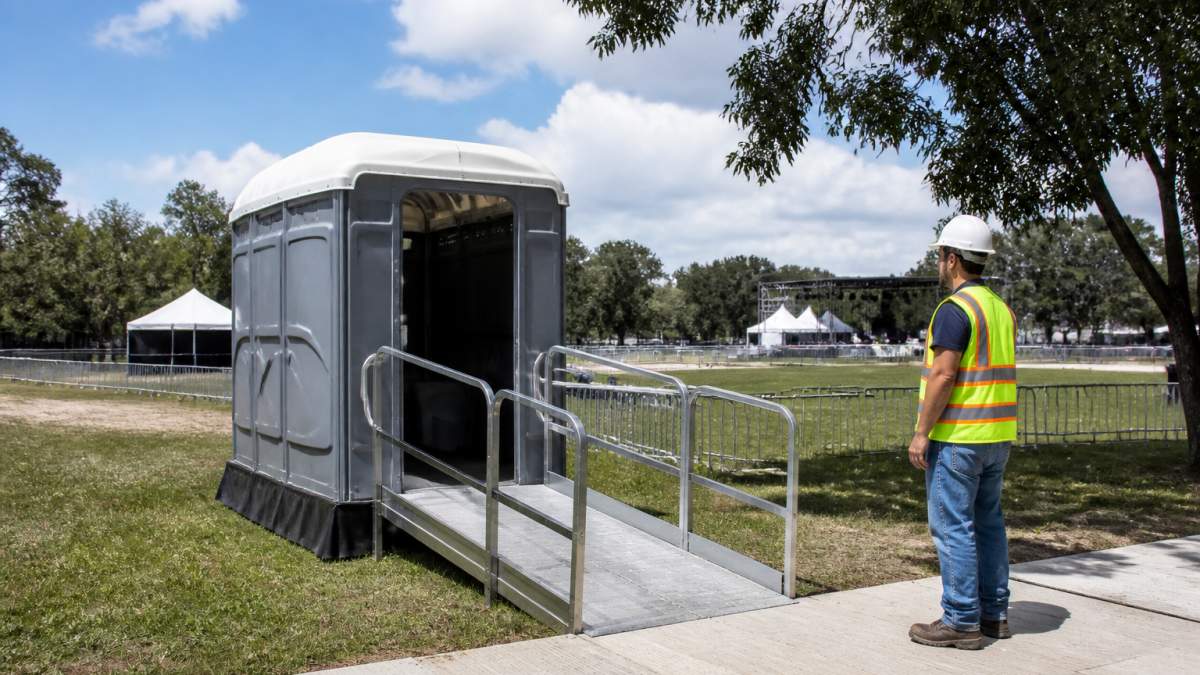
Weather and ground conditions belong in the plan too. A ramp stable in dry conditions can become slick or shift after rain, and soft ground can undermine a pad over a multi-day event.
If your project also falls under federal worksite rules, our guide to OSHA portable toilet requirements explains how the counts intersect, and our portable toilet event calculator can size the total order before you set the accessible share.
Requesting an ADA Compliant Portable Toilet Rental Quote
A good rental quote answers five questions before you sign: how many accessible units, what dimensions and grab bar specs, what servicing schedule, what delivery and pickup terms, and what the total cost includes. Ask for all five in writing. Providers who hesitate on dimensions or servicing terms are telling you something.
When you compare ada compliant portable toilet rental options, weigh the full package, not the headline rate. Nationwide coverage, reliable delivery and pickup, same-day emergency service, and ADA-compliant sanitation all belong in the decision.
The riskiest part of accessible sanitation is not the unit itself; it is the gap between what you ordered and what arrives on site. A unit without the right ramp, pad, or servicing schedule fails the people who need it most.
Frequently Asked Questions
How much does it cost to rent an ADA-compliant portable toilet?
Pricing for a single ADA unit varies by location, rental duration, delivery distance, and servicing frequency. Standard units are cheaper, and accessible units cost more because they are larger and need a ramp and reinforced grab bars. Request a written quote that lists delivery, pickup and servicing separately so nothing appears on the final invoice unexpectedly.
How many accessible portable toilets do I need for an event?
A common planning benchmark is that at least 5% of the toilets on site should be ADA-compliant, so a 100-unit setup would call for five accessible units. Large events with dispersed seating, multiple entrances or long queues often need more than the minimum to keep wait times reasonable. Place each accessible unit on a firm, level surface with a clear path at least 36 inches wide, and spread them across the site rather than clustering them at one gate.
What is the difference between a standard and an ADA portable toilet?
A standard unit is a compact single stall reached by a few steps. An ADA-compliant unit is much larger, often around 8 by 8 feet, with a ramped entrance, a wide door opening, a spacious interior for turning a wheelchair, and reinforced grab bars. That extra footprint and hardware is why accessible units cost more and why they need more room on site. If your crowd includes attendees or workers with mobility restrictions, the accessible unit is the one that keeps you compliant.
Can I rent an accessible restroom trailer instead of a portable toilet?
Yes. An accessible restroom trailer provides wheelchair access, running water, lighting and climate control, and it suits weddings, corporate events and long-duration projects where guest accommodation matters. Trailers cost more than stand-alone units and need level ground, a power source and water hookups, so confirm site access before booking. Many organizers pair one accessible trailer with several standard units to balance cost against comfort.
How often should a rented accessible portable restroom be serviced?
Weekly servicing is typical for a construction site, and many standard-unit rentals include one cleaning per week. Events usually need servicing before opening and again during multi-day runs, with pump-outs scheduled once wastewater capacity nears its limit. Confirm the servicing schedule in writing and ask what happens if a unit is missed, since an unserviced accessible unit can fail an inspection and take the only wheelchair-accessible option offline.
