
Last Updated: November 2, 2026
Quick Summary
Construction equipment logistics is the process of planning, moving, tracking, and maintaining heavy equipment and site assets across multiple job sites. Managing it nationwide requires seven steps worked in order: a planning framework, centralized tracking, fleet allocation rules, shared scheduling, dispatch and transportation planning, permits and compliance, and monthly cost and downtime measurement.
- Map written project requirements for each active site and review the map weekly as phases change.
- Central visibility comes from consistent logging, not software: every asset gets a unique ID and home region.
- Write allocation rules down so equipment moves to the site that needs it most, not the site that calls first.
- Plan corridors and backhauls before booking single loads to cut empty return miles.
- Most multi-state moves need a separate permit for each state on the route, so apply early.
Table of Contents
- Why Nationwide Equipment Logistics Breaks Down
- Step 1: Build Your Construction Equipment Logistics Planning Framework
- Step 2: Centralize Construction Equipment Tracking and Asset Visibility
- Step 3: Apply Construction Equipment Fleet Management Across Regions
- Step 4: Master Equipment Scheduling for Construction Projects
- Step 5: Plan Transportation, Dispatch, and Delivery Scheduling
- Step 6: Cover Permits, Compliance, and Oversized-Load Requirements
- Step 7: Measure Cost, Fleet Performance, and Downtime
- What to Do Next
- Frequently Asked Questions
Why Nationwide Equipment Logistics Breaks Down
Construction equipment logistics is the process of planning, moving, tracking, and maintaining heavy equipment and site assets across multiple job sites.
A project manager coordinates three sites in one metro and everything works. Add four more sites in three more states and the same playbook falls apart.
The breakdowns are predictable:
- Equipment sits idle on one site while another site rents a duplicate
- Delivery windows slip because no one owns dispatch across regions
- Inspections lapse when records live in different systems
Below are seven steps that fix this, worked in order since each builds on the last.
Step 1: Build Your Construction Equipment Logistics Planning Framework
Equipment logistics planning is the discipline of matching project requirements to equipment availability before anything moves. The framework comes first because every later step depends on it.
For guidance on selecting vendors, see our guide to renting on-site services for construction projects.
Map Project Requirements Before You Move Anything
Start with a written requirements map for each active project. List what each site needs, when it needs it, and how long it stays.
Review the map weekly as phases change.
- Equipment type and quantity per phase
- Required on-site dates and duration
- Site access limits, such as gate width and load capacity
Set Lead Times and Source Information Standards
Lead times decide whether a project starts on schedule or stalls. Set a standard for how lead times get recorded and who updates them.
Build buffer into the plan rather than discovering the gap later.
Step 2: Centralize Construction Equipment Tracking and Asset Visibility
Construction equipment tracking is the practice of recording where every asset is, what condition it is in, and who is responsible for it, in one shared system.
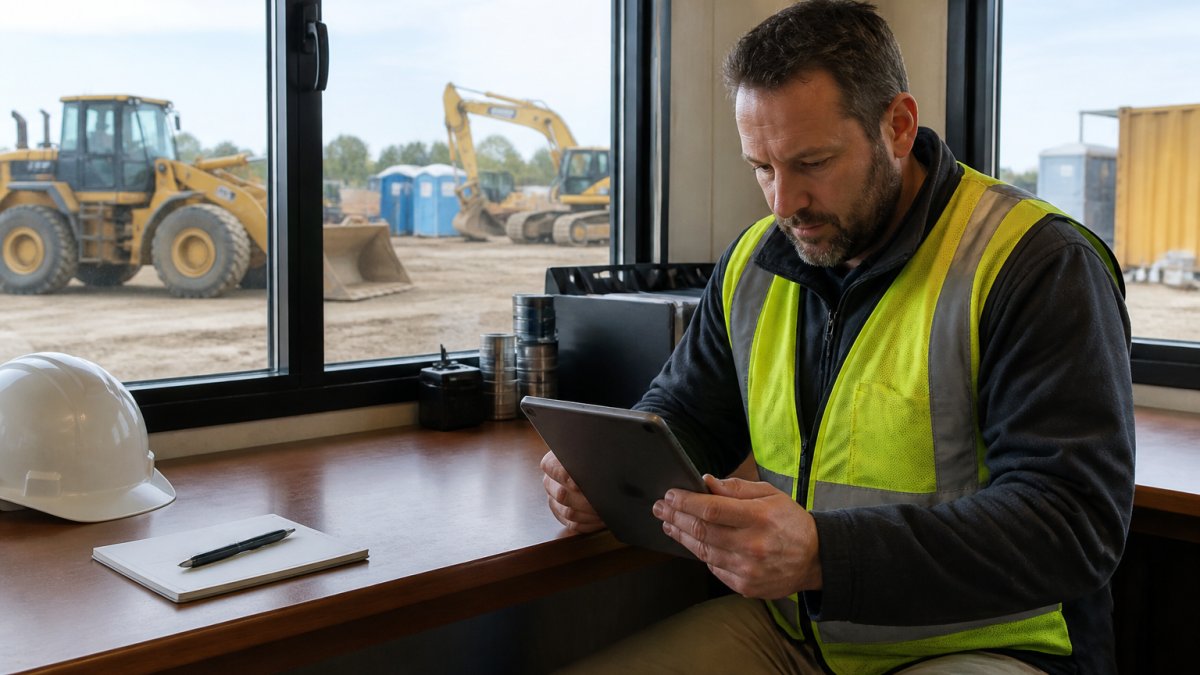
Asset visibility means one source of truth. Pick a system and enforce it.
The rules that make it work:
- Every asset gets a unique ID and a home region
- Every move gets logged with date, destination, and owner
- Every site checks assets in and out
What most guides miss is the discipline: software does not create visibility, consistent logging does.
Step 3: Apply Construction Equipment Fleet Management Across Regions
Construction equipment fleet management is how you decide which machine goes where and whether it earns its keep. At national scale, the goal is simple: move equipment to the site that needs it most, not the site that shouts loudest.
Equipment Use and Allocation Rules
Write allocation rules down so decisions do not depend on who calls first. A workable set:
- Fill active sites before filling standby sites
- Move underused equipment before renting new units
- Give priority to sites with hard deadlines and penalty clauses
Equipment deployment improves when the rules are public. For help streamlining project operations with precision and safety, see Project And Event Management. Teams stop hoarding machines when they know the rules apply equally.
Step 4: Master Equipment Scheduling for Construction Projects
Equipment scheduling for construction projects is the calendar layer: which asset is committed to which site on which dates. Poor scheduling creates two failures at once, idle equipment on one site and a shortage on another.
Build one shared schedule across all regions. Then protect it:
- Block dates for each asset before the project starts
- Flag conflicts at least two weeks out
- Hold a small reserve pool for emergencies
Release dates matter as much as delivery dates: equipment that never gets released never gets redeployed.
Step 5: Plan Transportation, Dispatch, and Delivery Scheduling
Transportation planning and dispatch is where most nationwide operations lose money. Every move costs time, fuel, permits, and risk, and unplanned moves multiply all four.
Route and Corridor Planning
Start with corridors, not individual loads. A corridor is a repeatable lane between regions, such as a north-south interstate spine connecting three active sites. Batching moves along a corridor lets you combine loads, negotiate consistent carrier rates, and cut empty return miles.
Practical rules:
- Group moves by corridor and by week before booking any single load
- Prefer backhaul opportunities so a trailer does not return empty
- Check route restrictions early, low bridges, weight-limited roads, and seasonal closures change the plan
Carrier Selection and Load Planning
Not every carrier can move every machine. Match the carrier to the load before you request a rate:
- Flatbed and step-deck for most compact and mid-size equipment
- RGN (removable gooseneck) and lowboy for heavy and tall machines
- Specialized heavy-haul for loads that exceed standard legal dimensions
Load planning is where cost is won or lost. Confirm the machine’s transport weight and dimensions from the spec sheet, not memory, and account for attachments, counterweights, and fuel. A load legal on one route may need a permit on another because state limits differ.
Build a one-page load profile for each high-value machine, weight, dimensions, attachment list, and preferred trailer type. Dispatchers who work from a load profile book fewer rejected loads and fewer re-quotes.
Delivery Windows and Site Readiness
Book dispatch windows, not just dates. For on-schedule nationwide delivery, see Commercial & Construction Dumpster Rental. A window tells the carrier and the site when the truck will arrive, which lets the site stage unloading equipment and clear access. Before the truck rolls, confirm:
- Gate width and overhead clearance
- Ground conditions and load capacity at the unloading point
- Unloading equipment on site (crane, forklift, ramps)
Sending a truck without confirming gate access and unloading space is the most common cause of a wasted dispatch day. A rejected delivery can cost a full day of truck time plus a re-delivery fee.
Return Movements and Asset Recovery
Plan the return leg at the same time you plan the outbound leg:
- Schedule pickup windows when the equipment is released, not after
- Inspect and document condition at pickup to support damage claims
- Route the return to the next site that needs the machine, not automatically to the yard
Dispatch Cost Trade-offs
Every dispatch decision trades cost against speed and risk. A workable decision framework:
- Consolidate when schedule allows, combining two loads on one corridor usually beats two single loads
- Expedite only when the downtime cost exceeds the premium freight cost
- Hold when the receiving site is not ready, a staged load in the yard is cheaper than a rejected delivery
A same-day option is worth keeping for emergencies, but treat it as an exception. If emergency dispatches become routine, the planning process upstream is failing.
Step 6: Cover Permits, Compliance, and Oversized-Load Requirements
Oversized-load rules and site compliance are the part teams underestimate. Moving heavy equipment across state lines can trigger permit requirements, escort rules, and route restrictions that vary by state. A nationwide guide has to explain the mechanism, not just list the paperwork.
How Oversized-Load Permitting Works
Permits are issued by state departments of transportation, and most multi-state moves require a separate permit for each state on the route. The permit is tied to specific dimensions, weight, and often a specific route. Key mechanics:
- Legal limits vary by state. A load legal without a permit in one state may be oversize in the next. Confirm axle weights and overall dimensions against each state’s limits.
- Permit types differ. Single-trip permits cover one move; annual or blanket permits cover repeated similar loads and pay off on high-frequency corridors.
- Route-specific permits may require an approved route, adding miles and time.
Apply early. Turnaround varies by state and load complexity, and a permit that worked last quarter may not cover this load because rules and limits change.
Escorts, Flags, and Safety Requirements
Many states require pilot cars or escort vehicles when a load exceeds certain dimensions. Requirements typically depend on width, length, and overhang, and they vary by state. Plan for:
- Front and/or rear pilot cars where required
- Warning flags, banners, and lighting on overhangs
- Travel restrictions, some states limit oversize travel to daylight hours or restrict it on holidays and weekends
Travel restrictions are easy to miss. A permit may be valid but still prohibit movement at night, on weekends, or during holiday periods. Build the travel window into the dispatch plan, not the permit alone.
Insurance, Liability, and Cargo Coverage
Confirm coverage before the load moves. A common gap sits between the carrier’s auto liability and cargo coverage on high-value equipment. Verify:
- The carrier’s operating authority and insurance certificates
- Cargo coverage limits against the value of the machine
- Whether the shipper’s own equipment policy or the carrier’s policy responds to damage in transit
Site-Level Compliance
Permits get the machine to the gate; site compliance gets it unloaded and operating. For a deeper guide on temporary construction fencing rules and options, see Temporary Construction Fences: Everything You Need to Know.
A practical compliance checklist:
- Confirm permit needs for each state on the route
- Check weight and dimension limits before dispatch
- Arrange escorts where required
Build a Repeatable Compliance Process
Treat compliance as a process, not a per-move scramble:
- Keep a permit matrix by state for the corridors you run most often
- Assign one owner for permit applications and renewals
- Log every permit, escort, and travel restriction against the dispatch record
Check current requirements with the relevant state transportation authority before every long move. A documented process keeps a nationwide operation compliant when one load crosses four states in a week.
Step 7: Measure Cost, Fleet Performance, and Downtime
Cost and performance measurement turns logistics from a cost center into a managed process.
Track these numbers monthly:
- Equipment use rate by region
- Downtime hours and causes
- Cost per move and cost per site
For a partner for site services across multiple locations, see why teams choose Site Services USA for job site rentals.
Quick reference: the seven steps
| Step | Focus | Review Cadence |
|---|---|---|
| 1 | Planning framework and requirements map | Weekly |
| 2 | Centralized tracking and asset visibility | Daily logging |
| 3 | Fleet management and allocation rules | Monthly |
| 4 | Equipment scheduling across regions | Weekly |
| 5 | Transportation, dispatch, and delivery | Per move |
| 6 | Permits, compliance, oversized loads | Per move |
| 7 | Cost, performance, and downtime metrics | Monthly |
What to Do Next
Running equipment logistics across multiple states is hard, and the hardest part is finding one partner who can handle site services without dropping the ball. Site Services USA provides nationwide coverage for portable toilets, dumpsters, temporary fencing, and storage containers, with fast, reliable delivery and pickup, same-day emergency service, and ADA-compliant portable sanitation.
Frequently Asked Questions
How do you manage equipment across multiple construction sites?
The goal is to see every asset in one place before you decide where it goes next, not after a project manager calls asking where the skid steer went.
What is construction equipment fleet management, and how does it differ from logistics?
Construction equipment fleet management covers the asset itself over its full lifecycle: acquisition, inspection, preventive maintenance, utilization, and return on investment. Logistics covers movement: which machine goes to which site, when, on what truck, and under what permits. The two overlap constantly. A fleet manager who ignores logistics ends up with machines sitting idle in the wrong state, and a logistics team without fleet data schedules moves for equipment that is down for service. Run both from the same asset records so utilization and deployment decisions use the same numbers.
How can contractors track equipment between job sites?
Use a combination of GPS or telematics on high-value heavy equipment and a simple scan or sign-out step for smaller tools and materials. Every transfer should generate a record with three data points: departure time, expected arrival, and confirming signature at the receiving site. That record is what lets you answer a project manager in seconds instead of making phone calls. For equipment you rent rather than own, confirm pickup and return dates in writing, because rental clock disputes are one of the most common hidden equipment costs on multi-site work.
What causes equipment logistics delays on construction projects?
The usual culprits are late project requirement changes, supply shortages and long lead times on specialty equipment, missing permits for oversized loads, and delivery windows that were never confirmed with the site. Weather and traffic add friction but rarely cause the first delay. Build slack into equipment scheduling for construction projects, and review upcoming moves regularly. Most delays are visible a week out if someone is actually looking at the schedule.
