
Table of Contents
- Types of Temporary Fencing: A Side-by-Side Comparison
- Temporary Fence Panels: Chain-Link, Welded-Wire, and Mesh Options
- Construction Fencing vs. Temporary Fencing for Events
- A Decision Framework: Matching Site Conditions to Fence Type
- Wind Loading, Anchoring, and Stability on Uneven Terrain
- Temporary Fence Installation and Inspection Guidance
- Temporary Fence Cost: Rental vs. Purchase and Budget Factors
- Conclusion
- Frequently Asked Questions
Last Updated: October 19, 2026
Types of Temporary Fencing: A Side-by-Side Comparison
Choosing the right temporary fencing type starts with knowing the four main families: chain-link panels, welded-wire panels, polyethylene mesh, and steel barricades. Each one solves a different problem. Pick the wrong one and you either overspend or leave your site exposed. We help construction managers and event organizers match fence type to job conditions every day.
Temporary fencing is a freestanding, relocatable barrier system used to secure construction sites, control crowds, and define perimeters without permanent posts or concrete footings.
Here’s the short version before the details:
| Fence Type | Best For | Setup Speed | Wind Resistance | Reuse |
|---|---|---|---|---|
| Chain-link panels | Construction perimeters | Fast | High with bases | High |
| Welded-wire panels | Events, crowd lines | Fast | Moderate | High |
| Polyethylene mesh | Privacy, dust control | Fastest | Low to moderate | Moderate |
| Steel barricades | Crowd control, parades | Fast | High | High |
Most guides skip the comparison and jump straight to chain-link. That’s a mistake. Event planners who rent chain-link for a weekend festival may pay for security they don’t need.
Temporary Fence Panels: Chain-Link, Welded-Wire, and Mesh Options
Temporary fence panels come in three core builds, and each has a clear job. Chain-link panels use galvanized steel mesh on a tubular frame. Welded-wire panels use stiffer, smaller-grid wire.
Chain-link panels are the workhorse of construction fencing. They stand up to wind, hold up for months, and accept privacy screens and windscreen fabric. The trade-off is weight.
Welded-wire panels give you a cleaner look and tighter grid. They suit event perimeters and crowd lines where appearance matters. They are less forgiving on rough ground than chain-link.
Polyethylene mesh is the lightest option. It blocks sight lines, contains dust, and goes up fast. It will not stop a determined intruder, so treat it as a visual and debris barrier, not site security.
- Chain-link: durable, heavy, best for long projects
- Welded-wire: tidy, medium weight, best for events
- Mesh: lightest, fastest, best for privacy and dust
Ask your supplier whether the panel feet are the blow-molded plastic type or concrete-filled. Plastic feet slide on asphalt in high wind. Concrete feet stay put but cost more to deliver.
Construction Fencing vs. Temporary Fencing for Events
Construction fencing and event fencing look similar but follow different rules. Construction fencing prioritizes site security, durability, and long rental periods. Event fencing prioritizes crowd management, quick setup, and appearance.
On a construction site, the fence keeps people out and materials in. It needs to survive months of weather, stay anchored, and hold up to equipment bumps. Heavy-duty chain-link with concrete bases is the standard choice.
At a public event, the fence keeps crowds moving in the right direction. Steel barricades and welded-wire panels do that job well. They set up in hours and come down just as fast.
Here’s the part most people get wrong: they rent construction-grade panels for a one-day event. That can add delivery weight, setup time, and cost for no real benefit.
- Construction: prioritize stability and durability
- Events: prioritize speed, sight lines, and crowd flow
- Mixed use: chain-link with removable privacy screen
A Decision Framework: Matching Site Conditions to Fence Type
Most selection guides list fence types and leave you to guess. This framework does the opposite: it walks four inputs in a fixed order, duration, ground, exposure, and access, and returns a defensible fence choice. Work the steps in sequence; later steps can override earlier ones, and that override is the part most guides skip.
Step 1: Duration sets the weight class.
- Under one week: polyethylene mesh or welded-wire panels. Setup labor dominates cost at this duration, so lighter panels win even if they cost more per panel.
- One week to three months: welded-wire or chain-link. This is the crossover zone where durability starts paying for itself.
- Three months or longer: chain-link with concrete-filled bases. Plastic blow-molded feet degrade under UV and repeated handling; concrete bases hold up across multi-month rentals.
Step 2: Ground conditions set the anchoring method.
- Asphalt or concrete: standard panel feet work, but plastic feet can slide under lateral load. Concrete feet or weighted ballast are the safer default on smooth hardscape.
- Gravel or compacted dirt: heavier bases and a level check at each joint. Gravel shifts, so recheck plumb after the first wind event.
- Sod, sand, or soft ground: panel feet alone will sink or migrate. Plan on ground stakes, ballast, or a combination, and expect slower setup.
- Slopes: step the run rather than forcing a level line. Each panel should sit plumb on its own footprint.
Step 3: Exposure and risk set the panel grade.
- Crowd direction only (parades, queue lines): steel barricades. They are designed to be moved by the crowd and reset, not to stop intrusion.
- Theft or trespass risk: chain-link with privacy screen. The screen removes sight lines, which is the deterrent most intruders respond to; the panel provides the physical delay.
- Dust, debris, or visual screening: polyethylene mesh. Treat it as a visual and containment barrier, not a security barrier.
- Open lots, elevated sites, or long unobstructed runs: upgrade to heavy-duty panels and plan bracing before you order. Wind exposure, not duration, should drive this upgrade.
Step 4: Public access and egress set the layout.
- Any site the public can approach needs defined pedestrian routes, visible gates, and emergency egress that swings freely. A fence line that traps people in a dead end is a liability, not a perimeter.
- Events with backstage or restricted zones: use privacy screen on the restricted side and keep the public side open for sight lines and crowd flow.
- Construction sites with active deliveries: plan gate locations before you set the first base. Moving a gate after the run is up costs labor you did not budget.
Step 5: Budget confirms, it does not decide.
Rental usually wins for short jobs because it bundles delivery, pickup, and maintenance into one line. Purchase only makes sense if you fence sites most months of the year and can store and service panels yourself. If the framework points to a fence type your budget cannot support, adjust duration or exposure assumptions, not the safety margin.
Duration decides the weight class. Ground decides the anchoring. Exposure decides the grade. Access decides the layout. Run the steps in that order and the fence type falls out of the inputs rather than the catalog.
Wind Loading, Anchoring, and Stability on Uneven Terrain
Wind is the leading cause of temporary fence failures, and the mechanism is simple: a panel is a flat surface, and a flat surface catches wind.
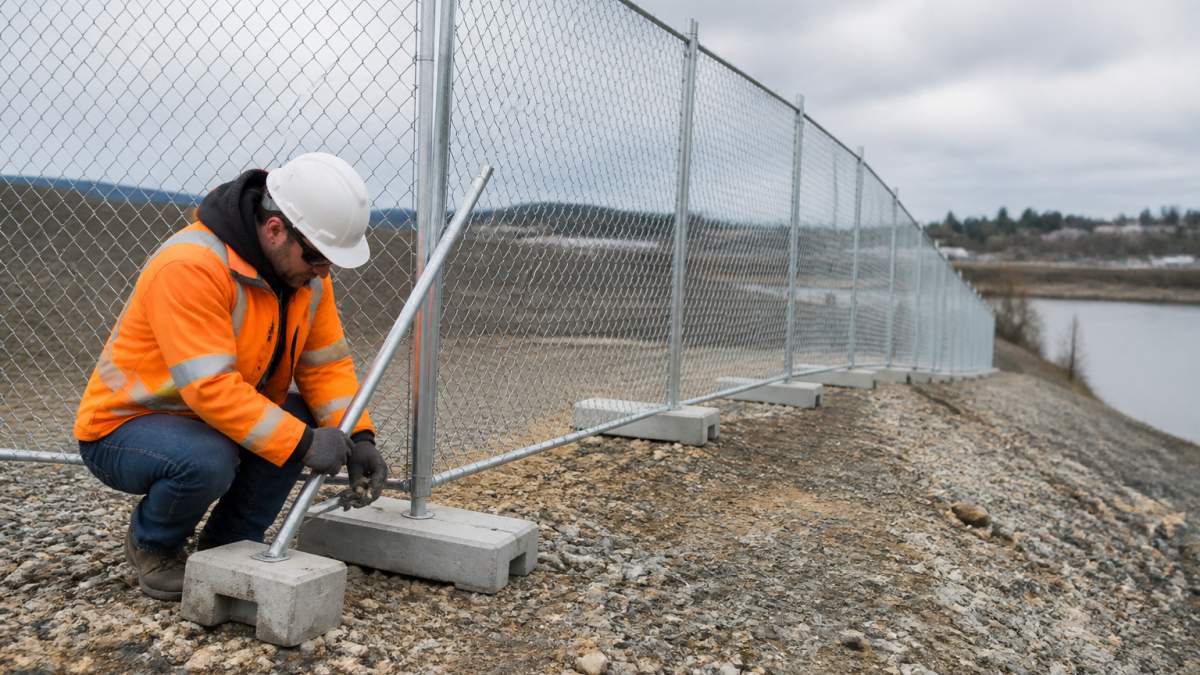
How wind load actually builds.
Wind pressure rises with the square of wind speed, so a modest increase in gust speed produces a disproportionate increase in load on the panel.
Anchoring choices and their trade-offs.
- Blow-molded plastic feet: lightest to deliver and handle, but they slide on smooth hardscape and degrade under UV over multi-month rentals. Fine for short event runs on grass or gravel.
- Concrete-filled bases: heavier to deliver and set, but they resist sliding and stay put across long rentals. The default for construction perimeters and any run with a screen.
- Ground stakes: effective on sod, sand, and soft dirt, but useless on asphalt or concrete. Pair with ballast on mixed surfaces.
- Ballast (sandbags, water weights): a supplement, not a substitute. Ballast helps most when placed at corners and gate posts where load concentrates.
Bracing is not optional on long runs.
Diagonal braces at corners and at intervals along long straight runs resist the racking force that tips a panel.
Uneven terrain.
Panels on a slope gap at the bottom or lean because the feet cannot find a common plane.
When to bring in a professional assessment.
Most short event runs on sheltered ground do not need engineering review. The OSHA construction standards treat fencing as part of site access and fall protection planning, so stability is a safety obligation, not a convenience.
- Match base weight to wind exposure, not to panel count
- Brace every corner and gate post; add intermediate bracing on exposed runs
- Stake or ballast on soft ground; concrete feet on hardscape
- Step panels down slopes, never force a level line
- Recheck anchors and couplers after every storm and after any vehicle impact
A screened run with plastic feet on asphalt is the most common under-anchored setup we see. The screen looks like a privacy add-on; in a gust it is the load that tips the run.
Temporary Fence Installation and Inspection Guidance
Temporary fence installation follows a repeatable sequence. Plan the line, set the bases, connect the panels, then inspect before you call it done.
- Walk the perimeter and mark corners and gate spots
- Set bases at each panel joint, level on the ground
- Stand panels into the bases and lock the couplers
- Brace corners and any run over a set length
- Add privacy screen or windscreen last
- Inspect every panel, base, and coupler
Inspection checklist:
- Every panel seated fully in its base
- Couplers locked at each joint
- Corner braces in place
- No gaps at ground level
- Gates swing freely and latch
- Screen tied down, not flapping
Inspect after high wind, after any vehicle impact, and at least weekly on long jobs. A loose coupler is easy to fix today and expensive to explain after a panel falls.
Skipping the post-setup inspection is the most common mistake we see. One unlocked coupler can drop a whole run in a gust, and that becomes a safety and liability problem fast.
Temporary Fence Cost: Rental vs. Purchase and Budget Factors
Temporary fence cost depends on quantity, rental length, delivery distance, and base type. We don’t publish flat rates because every job differs. Request a quote and you’ll get pricing tied to your panel count, dates, and site access.
Rental usually wins for short jobs. You avoid storage, maintenance, and transport between sites. Purchase only pays off if you fence sites most weeks of the year and can store and service panels yourself.
Budget factors to plan for:
- Panel count and total linear feet
- Rental duration and extension terms
- Delivery, pickup, and any after-hours fees
- Base type: plastic versus concrete
- Privacy screen or windscreen add-ons
- Gates, braces, and corner hardware
Ask for an all-in quote that lists delivery and pickup separately. That’s how you avoid surprise line items later.
For a deeper look at safety expectations on active sites, the CPSC public safety guidance and OSHA temporary worker guidance are worth a read before you finalize a layout.
Conclusion
The hardest part of temporary fencing isn’t the panels. It’s matching the fence to the job before the truck arrives. Get duration, ground conditions, and risk right, and the rest falls into place.
Site Services USA delivers temporary fencing, portable toilets, dumpsters, and storage containers nationwide, with fast delivery and pickup and same-day emergency service available. One vendor, one schedule, fewer headaches.
Request a quote from Site Services USA and lock in the right fence for your site.
Frequently Asked Questions
What type of temporary fence is strongest?
Welded-wire panels on steel bases are the strongest standard option for construction sites, because the welded joints resist deformation better than woven chain-link. For crowd control at events, steel barricades with interlocking feet outperform lightweight mesh. Strength also depends on anchoring: a heavy-duty panel on loose dirt can still tip in high wind, so pair strong panels with proper ballast or ground stakes and inspect after storms.
What is the difference between chain-link panels and crowd-control barriers?
Chain-link panels are full-height fence sections (often 6 feet) with mesh infill, used for perimeter security and site containment. Crowd-control barriers, sometimes called steel barricades, are shorter interlocking units designed for pedestrian flow and queue management at events. Chain-link blocks access; barricades guide people. Many large outdoor festivals use both: barricades at entrances and stages, chain-link around the perimeter and back-of-house areas.
How can I make temporary fencing more stable and secure?
Stability comes from three things: correct bases, proper alignment, and wind management. Use concrete-filled bases or ground stakes matched to your surface (asphalt, gravel, dirt, or sod). Keep panels in a straight line or gentle curve rather than sharp angles that catch wind. Add privacy screen or windscreen only when needed, since solid fabric increases wind load. Inspect footing and connections after heavy weather, and brace corners and gate openings, which take the most stress.
How much does temporary fence cost, and is rental or purchase better?
Pricing depends on quantity, project duration, delivery distance, and panel type, so request a quote for current rates. As a rule, rental makes sense for short projects and one-time events, while purchase pays off for contractors who need fencing repeatedly across multiple jobs. Factor in delivery, pickup, installation labor, and any damage waivers, not just the per-panel rate, to get a true total cost of ownership.