
Last Updated: November 14, 2026
Quick Summary
Small business construction site equipment needs fall into four practical buckets: earthmoving and digging, lifting and material handling, compaction and grading, and site services that keep a job clean and compliant. Compact machines like mini excavators, skid steers, and compact track loaders handle most small-project work, and renting beats buying for machines used fewer than a few times a quarter.
- Match attachments to the work you bid most often, not the work you hope to win.
- Measure the narrowest gate or side yard before choosing a machine size.
- Buy when use is high and the work is repeatable; rent for one-off specialty work.
- Tracked machines cost more to maintain than wheeled ones, and tracks wear faster on pavement.
- Portable toilet rental for construction sites is a compliance requirement, not a convenience.
Table of Contents
- Essential Construction Site Equipment for a Small Crew
- Heavy Equipment and Compact Machines That Fit Small Projects
- Attachments That Extend What One Machine Can Do
- Matching Equipment Capacity to Your Project Requirements
- Renting vs Buying Construction Equipment for Small Business
- Construction Site Safety Equipment Requirements You Cannot Skip
- Portable Toilet Rental for Construction Sites and Site Logistics
- Request a Quote and Build Your Site Equipment Plan
- Frequently Asked Questions
Essential Construction Site Equipment for a Small Crew
A small crew does not need every machine on the dealer lot.
Equipment decisions compound quickly. Buy too much, and you carry debt and maintenance on machines that sit idle. Buy too little, and you turn down profitable work.
Below, we break down the core categories every small contractor should understand, from digging equipment to site services, and show where rental beats ownership.
The Core Categories Every Jobsite Needs
Small business construction site equipment needs fall into a few practical buckets: earthmoving and digging, lifting and material handling, compaction and grading, and the site services that keep a job clean and compliant.
A frequent mistake is buying the biggest machine the budget allows instead of the right one for the project scale. A mini excavator that fits through a gate beats a full-size machine that cannot reach the backyard.
Heavy Equipment and Compact Machines That Fit Small Projects
Compact equipment is where most small contractors should start. Mini excavators, skid steer loaders, and compact track loaders deliver the digging, lifting, and material transport that used to require full-size heavy equipment, and they fit on tight residential jobsites.
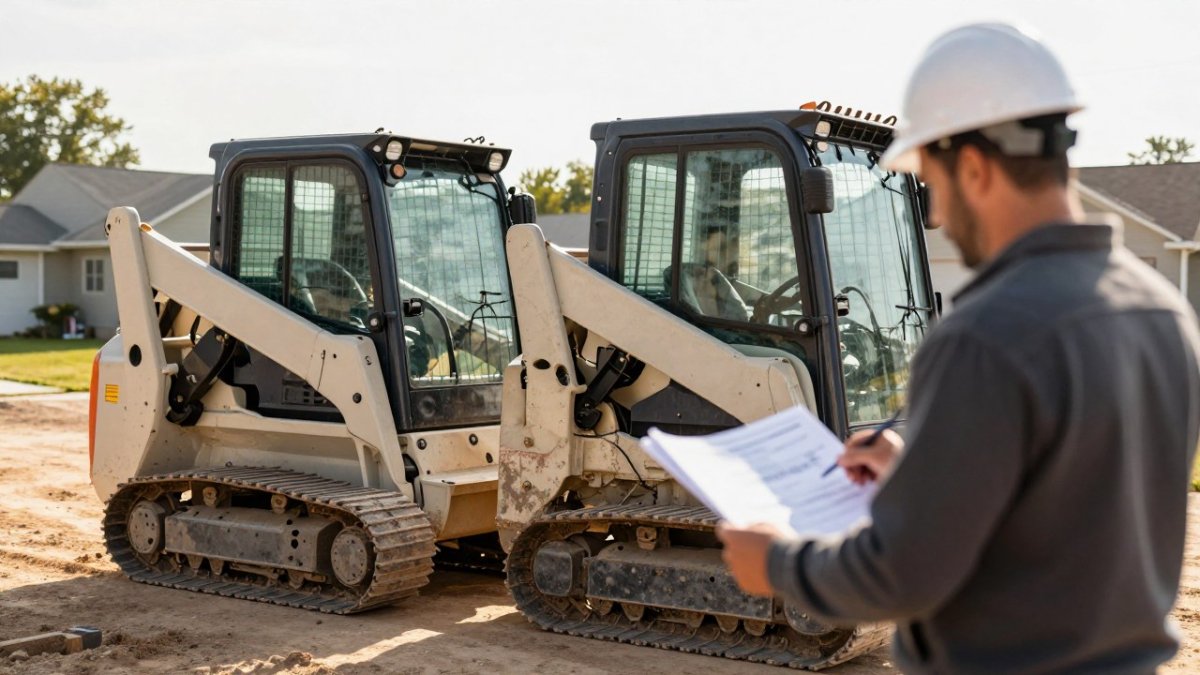
Mini Excavators, Skid Steers, and Compact Track Loaders
A mini excavator is a tracked digging machine built for trenches, footings, and tight-access excavation, handling site prep and grading that would otherwise be shovel work.
A skid steer loader is a rigid-frame machine that turns in its own footprint, making it the workhorse for material handling on cramped sites.
Here is how the three compare for a small operation:
| Machine | Primary Job | Best For | Buy or Rent |
|---|---|---|---|
| Mini excavator | Digging, trenching, grading | Tight-access excavation | Rent for occasional digs |
| Skid steer loader | Lifting, material transport | Flat, paved jobsites | Buy if used weekly |
| Compact track loader | Lifting, earthmoving on soft ground | Mud, slopes, landscaping | Rent for seasonal work |
The honest trade-off: tracked machines cost more to maintain than wheeled ones, and tracks wear faster on pavement.
Attachments That Extend What One Machine Can Do
Attachments turn one carrier machine into several tools and are the cheapest way to expand capability without buying another engine. A bucket handles digging and material transport; a hammer breaks concrete and rock; forks convert a loader into a lifting machine; a rake clears debris and grades soil.
The practical rule: match attachments to the work you bid most often, not the work you hope to win. A hammer you use twice a year is money sitting in the yard.
Matching Equipment Capacity to Your Project Requirements
Machine size should follow project requirements, not the other way around. Before you buy or rent, map the job: access width, soil type, lift heights, and daily material volume.
“Project requirements” means something different for a landscaper than for a concrete crew, so a one-size-fits-all list does not help a small business decide. Below are the selection checkpoints that actually change the machine you choose, followed by trade-specific starting points.
The Four Capacity Questions to Answer First
- Access. Measure the narrowest gate, doorway, or side yard the machine must pass through. A mini excavator in the roughly 1- to 2-ton class is commonly chosen for residential backyards because it fits through a standard gate; confirm published width against your tightest access point before you commit.
- Dig depth and reach. Match rated dig depth to the deepest trench or footing, then add margin. A machine working at maximum depth every day wears faster and is slower than one with headroom.
- Lift capacity at reach. Loaders are rated at a specific load center, and capacity drops as you extend the boom or raise the load. Check rated operating capacity at the reach you will actually use, not the headline spec.
- Production rate. Estimate daily material volume and cycles per hour. A machine that is too small stretches the schedule, and schedule is where small contractors lose margin.
Selection by Trade and Project Scale
A general contractor, a landscaper, and a concrete crew do not need the same starter package. Use these as starting points, then adjust for the work you bid most often.
- Landscaping and hardscaping. A compact track loader or skid steer with a bucket, forks, and a rake covers grading, material transport, and cleanup. Add a mini excavator for planting beds, drainage, or small retaining walls. Soft, muddy yards favor tracks over wheels.
- Remodeling and general contracting. A skid steer handles material handling and debris on tight lots; a mini excavator covers small footings and utility trenches. Many remodelers rent the excavator per project and own only the loader.
- Excavation and site prep. A mini excavator is the core machine, paired with a dump trailer or roll-off for spoil. Add a compact track loader for grading and backfill. This trade is the most likely to justify owning both.
Where Capacity Meets Site Services
Capacity also drives the support equipment. Once you know how much debris a project generates, sizing the right roll-off container becomes straightforward. You can rent a construction dumpster in the right size for the job rather than guessing and paying for a swap-out.
Underestimating debris volume is a common cause of a stalled cleanup. Order the next size up when demolition scope is uncertain, and confirm weight limits and placement access before delivery day.
A Quick Sanity Check Before You Commit
Before signing a purchase or rental agreement, walk the jobsite with the machine’s dimensions in hand: width at the narrowest access, turning radius, dig depth, and rated capacity at reach. If any one fails the job, the machine is the wrong size no matter how good the price looks.
Renting vs Buying Construction Equipment for Small Business
Renting vs buying construction equipment for small business comes down to use. If a machine runs most weeks, ownership usually wins on operating costs over time. If it runs a few times a season, rental rates beat a purchase price plus maintenance, insurance, and storage.
The math most guides skip is total cost of ownership: purchase price, financing, insurance, maintenance, downtime, and resale. A machine that sits idle still costs money every month.
Total Cost of Ownership, Line by Line
Add up every cost a machine carries whether or not it is working:
- Purchase price or financing. A loan or lease adds interest and a fixed monthly payment that continues through slow months. Compare the monthly payment against the rental rate for the same machine class.
- Insurance. Equipment coverage is typically separate from general liability. Confirm whether your policy covers owned machines, rented machines, or both, rental yards often require proof of coverage before a machine leaves.
- Maintenance and wear parts. Tracks, tires, filters, fluids, and cutting edges are consumables. Tracked machines generally cost more to maintain than wheeled ones, and tracks wear faster on pavement.
The Utilization Threshold
One practical approach is to compare the annual cost of ownership against the annual cost of renting the same machine for the days it would actually run. If you would use a machine fewer than a few times a quarter, rental usually wins once insurance, storage, and maintenance are included. If it runs most weeks, ownership tends to win on operating cost over time.
Realistic Budget Bands and a Sample Starter Package
Exact prices vary by region, condition, and dealer, so treat the following as general planning considerations rather than quotes. A used compact machine typically costs less than a new one but can carry more maintenance risk.
A low purchase price can hide a machine that needs immediate repairs, so have a used machine inspected by a mechanic before purchase.
Buy, Rent, or Rent First
- Buy when use is high and the work is repeatable.
- Rent for peak-season spikes, one-off specialty work, and any machine you would use fewer than a few times a quarter.
- Rent first, then buy the model you have actually run on a real jobsite.
For crews managing equipment across multiple sites, the logistics get complicated fast. Our guide on managing nationwide construction equipment logistics walks through the coordination steps.
Construction Site Safety Equipment Requirements You Cannot Skip
Construction site safety equipment requirements are not optional, and they are not just about machines. They cover personal protective equipment, fall protection, machine guarding, and sanitation on site.
Operator training matters as much as the equipment itself. An untrained operator on a mini excavator is a liability, and many rental agreements require proof of competence before a machine leaves the yard.
Sanitation is part of the same compliance picture. Our OSHA site compliance guide covers the full checklist.
Portable Toilet Rental for Construction Sites and Site Logistics
Site logistics decide whether a crew stays productive. Portable sanitation, temporary fencing, storage containers, and waste removal all have to arrive on schedule, and a missed delivery can stall a whole day.
Site Services USA provides portable toilet rental for construction sites, dumpsters, temporary fencing, and storage containers, with fast delivery and pickup, same-day emergency service, and ADA-compliant portable sanitation.
If you need sanitation on site, you can book portable toilet rental for your crew and get units scheduled around your project timeline.
Request a Quote and Build Your Site Equipment Plan
The right equipment plan balances owned machines against rented support equipment and keeps site services on a reliable schedule so the crew never waits.
Site Services USA handles portable toilets, dumpsters, temporary fencing, and storage containers nationwide, with fast delivery and pickup, same-day emergency service, and ADA-compliant sanitation.
Building a site equipment plan is easier when the support side is handled by one reliable partner.
Frequently Asked Questions
What equipment is needed for a small construction site?
A small construction site typically needs three groups of construction site equipment: production machines (a mini excavator or skid steer for digging and grading), hand and power tools (saws, drills, compactors, generators), and site support items (portable toilets, dumpsters, temporary fencing, and storage containers). Match the machine list to your project requirements first, then add support equipment so the crew can work safely and without downtime. Renting the larger machines for short phases keeps startup costs manageable.
How do you decide between renting vs buying construction equipment for a small business?
The deciding factor is utilization. If a machine runs most weeks of the year, buying can beat rental rates over time, but you take on maintenance, storage, transport, and repair downtime. If a machine is needed for a few weeks per project, renting shifts those costs to the rental company and keeps capital free. Many small contractors buy one workhorse loader and rent specialized machines like excavators or hammer attachments only when a job calls for them.
What are the OSHA sanitation requirements for portable toilet rental for construction sites?
OSHA’s sanitation standard (29 CFR 1926.51) sets minimum toilet counts based on crew size; confirm the current requirement at osha.gov before planning unit counts. Units must be kept clean and serviced, and the count must scale with headcount. Confirm your unit count before crews arrive, and schedule regular servicing so the site stays compliant through every phase of the project.
What compact machines offer the best return for small contractors?
Skid steer loaders and compact track loaders tend to earn their keep fastest because they handle lifting, grading, material transport, and cleanup across nearly every phase of a project. Mini excavators deliver strong returns on utility, landscaping, and demolition work where digging is the core task. Adding a bucket, forks, and a hammer attachment to one carrier machine multiplies its usefulness without buying a second machine, which improves equipment utilization and lowers your operating costs.
