
Last Updated: November 7, 2026
Quick Summary
Teams switch equipment vendors when the current supplier keeps costing them time they cannot get back through late deliveries, missed pickups, and slow swaps. A repeatable scorecard that weights delivery reliability, service response, coverage, cost transparency, contract terms, and references makes the comparison honest. Phasing the switch by site, with a one-to-two-week overlap on busy sites, prevents service gaps.
- Track every hour lost to late pickups, missed deliveries, and repair calls for one month.
- Score vendors 1 to 5 on six weighted categories and keep the completed scorecard with the contract.
- Ask vendors to put on-time delivery, same-day swap, and pickup rates in writing.
- Compare all-in cost per unit per month over a full year, including transition costs.
- Overlap the old and new vendors for one to two weeks on your busiest sites.
Table of Contents
- Why Construction Teams Switch Site Equipment Vendors
- Construction Equipment Vendor Evaluation: What to Measure Before You Commit
- Reliability, Downtime, and the Real Cost of a Late Delivery
- Questions to Ask Equipment Vendors Before Signing
- Your Construction Equipment Vendor Checklist
- Construction Equipment Delivery and Pickup: What a Clean Transition Looks Like
- Request a Quote and Compare Against Your Current Vendor
- Frequently Asked Questions
Why Construction Teams Switch Site Equipment Vendors
Switching construction site equipment vendors is the process of replacing your current supplier of portable toilets, dumpsters, fencing, or storage containers with a provider that better fits your schedule, budget, and compliance needs.
The decision rarely comes from a single bad delivery. It builds.
Below, we break down what drives the switch, how to evaluate equipment vendors before you commit, and what a clean transition actually looks like.
The Hidden Cost of Staying With a Vendor That Underperforms
Many teams underestimate what a weak vendor costs them. The invoice is the small number.
When a dumpster does not arrive on time, crews stack debris in walkways.
A common mistake is treating vendor problems as a scheduling annoyance instead of a cost.
Then there is compliance. Sanitation requirements on construction sites, including OSHA guidance on toilet facilities, are an important compliance consideration.
Staying is a choice. Make it a deliberate one.
Construction Equipment Vendor Evaluation: What to Measure Before You Commit
Construction equipment vendor evaluation starts with a repeatable scorecard, not a gut feeling. Many teams compare rental rates and stop there, which often leads to switching again later.
Build the scorecard around six weighted categories. Weight them to match your project mix; a team running multiple active sites should weight coverage and response time highest, while a single-site team can weight cost more heavily.
| Category | What to measure | Example KPI | Weight (multi-site) |
|---|---|---|---|
| Delivery reliability | On-time delivery and pickup rate | Percentage of deliveries inside the agreed window | 25% |
| Service response | Time to swap a unit or fix a problem | Hours to same-day swap; hours to emergency response | 20% |
| Coverage | Markets served and local service capacity | Number of markets with local dispatch and inventory | 20% |
| Cost transparency | All-in cost per unit per month | Rental rate plus delivery, pickup, swap, and fuel fees | 15% |
| Contract terms | Exit, swap, and auto-renewal language | Notice window in days; remedy for missed service | 10% |
| References and risk | Customer references and financial stability | Recent references in your sector; years in business | 10% |
Weight (multi-site)
Score each vendor from 1 to 5 in every category, multiply by the weight, and total.
Service KPIs That Separate Vendors
Ask every vendor to put these numbers in writing, not just describe them verbally:
- On-time delivery rate. Ask how they track it and whether they will share a monthly report. A vendor who cannot produce the number may not measure it.
- Same-day swap capability. On an active site, a broken portable toilet or a full dumpster cannot wait until next week. Ask for the cutoff time for a same-day request.
- Parts and inventory availability. For dumpsters, fencing, and storage containers, ask how many units they hold locally. Local inventory is what makes a same-day swap possible.
Some vendors quote strong delivery numbers but go quiet on pickup and swap metrics. Push on all three.
Total Cost of Ownership and Vendor Transition Costs
Total cost of ownership for site equipment includes more than the rental rate. It covers delivery, pickup, swap fees, fuel or environmental charges, and the labor hours lost when service fails.
Transition costs are real. Moving to a new vendor means new account setup, new contacts, a short learning curve for your site supervisors, and possibly overlapping service on your busiest sites.
Watch out: comparing only the headline rental rate can lead to picking the wrong vendor.
References, Due Diligence, and Vendor Risk
Before you commit, run a short due-diligence pass:
- Ask for three recent references in your sector. Call them and ask two questions: how often did service fail, and how fast was the fix?
- Check local service coverage. A national brand with no local dispatch can be slower than a regional provider with trucks nearby.
- Ask about financial stability and years in business. A vendor that cannot invest in inventory or trucks will struggle to keep up with your schedule.
- Confirm insurance and compliance support. Ask how they help you meet portable toilet ratios and other site requirements.
A simple scorecard keeps the comparison honest. Rate each vendor from 1 to 5 on the six categories above, weight them to your project mix, and keep the completed scorecard with the contract. If the vendor underperforms later, you have a documented baseline to compare against.
Reliability, Downtime, and the Real Cost of a Late Delivery
Equipment reliability is an important indicator of whether a vendor will work out.
Downtime is where reliability gets tested. A late delivery does more than delay one task. It cascades.
Ask any vendor two questions before you commit:
- What happens if a pickup is missed?
- How do you handle a same-day emergency?
The answers tell you more than any sales pitch. A vendor who cannot explain their backup plan may not have one.
Parts availability and service support matter here too. If a unit breaks, how fast does a replacement arrive?
Questions to Ask Equipment Vendors Before Signing
The right questions to ask equipment vendors expose gaps before they become your problem. Ask them in writing and keep the answers.
Run through this list:
- Coverage: Can you service every market we work in?
- Emergency service: What is your same-day response process?
- Compliance: How do you help us meet portable toilet ratios on site?
The reference question is the one most teams skip. Do not skip it. A vendor’s current customers will tell you what the sales rep will not.
Your Construction Equipment Vendor Checklist
A construction equipment vendor checklist turns a gut decision into a documented one. Use it to compare options side by side and to catch contract terms that cost you later.
| Check | What Good Looks Like | Why It Matters |
|---|---|---|
| Delivery reliability | On-time tracking shared upfront | Protects your schedule |
| Service response | Same-day swaps available | Cuts downtime |
| Coverage | One provider, many markets | Fewer vendors to manage |
| Cost clarity | All fees listed in writing | No surprise invoices |
| Contract terms | Clear exit and swap terms | Protects you if it fails |
| References | Recent customers in your sector | Proves the claims |
Contract, Warranty, and Service-Agreement Review
Read the contract before you sign, and review term length, exit terms, and any service commitments.
Look for auto-renewal clauses. Many agreements renew quietly unless you give notice. Note the notice window.
Check what the service agreement actually promises. A delivery schedule is not a guarantee unless the contract says so.
Watch out: a low rate paired with a long auto-renewing term can lock you into a vendor you already know underperforms.
Construction Equipment Delivery and Pickup: What a Clean Transition Looks Like
A clean transition runs on a written schedule and a phased rollout, not a single cutover day. The goal is no gap between the old vendor leaving and the new one arriving, especially on active sites where a missing dumpster or portable toilet stops work.
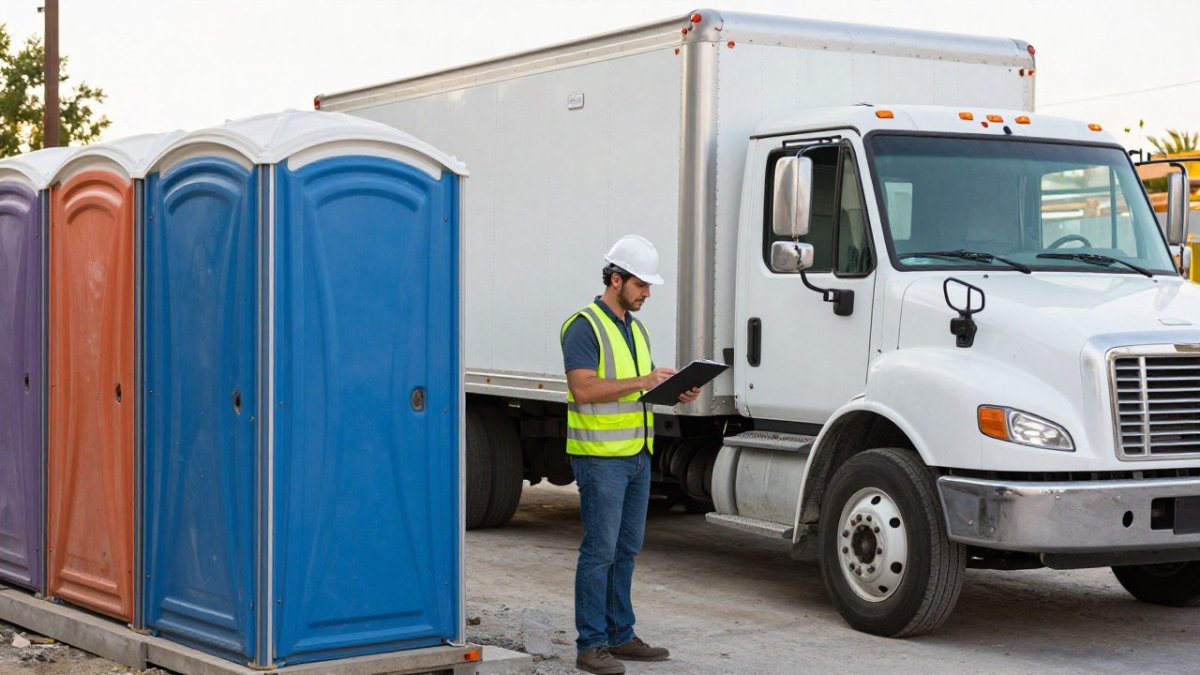
Phase the Switch by Site, Not All at Once
Most teams get burned by switching every site on the same day. Phase it instead:
- Start with one or two low-risk sites. Pick sites with stable schedules and forgiving deadlines. Use them to test delivery windows, swap response, and billing accuracy.
- Overlap the two vendors for one to two weeks on your busiest sites. Keep the old vendor’s units in place until the new vendor has delivered and confirmed the first pickup. Overlap costs a little; a gap costs more.
- Expand in waves. Move the next group of sites only after the first wave has run two full weeks without a missed delivery or pickup.
- Retire the old vendor site by site. Confirm each pickup in writing before you close the account.
Transfer Records and Set Up the Account
Before the first delivery, move the information that keeps service running:
- Unit list and site addresses. Confirm exact counts, unit types, and placement locations for each site.
- Delivery and pickup windows. Agree on windows, not just dates, and name one contact on each side who can authorize changes.
- Billing and PO details. Set up the account, purchase orders, and invoicing contacts so the first invoice does not stall.
Train Supervisors and Set the Escalation Path
Your site supervisors are the people who will notice a missed pickup first. Give them a one-page sheet with the new vendor’s contact, the same-day request cutoff time, and the escalation path if a delivery is late. A short briefing at the start of the first wave prevents most day-one confusion.
Review the First Two Weeks, Then Adjust
Schedule a review at the end of the first two weeks. Compare actual delivery and pickup times against the agreed windows, count any missed service, and adjust unit counts or windows before the next wave. This is also the moment to confirm the first invoice matches the quoted all-in cost.
A closed account with units still on site creates a billing dispute and can leave you without service if the new vendor hits a delay.
For teams coordinating across many locations, our guide on managing nationwide construction equipment logistics walks through the multi-site side of this in more detail.
Request a Quote and Compare Against Your Current Vendor
The last step is the easiest to get right and the easiest to rush. Request a quote, then compare it line by line against what you pay now.
Put the two side by side: rate, fees, delivery, pickup, and emergency service. Add the downtime cost you tracked earlier. The cheaper vendor on paper is often the more expensive one in practice.
If you want to see the full range of what one provider can cover, explore the site services offering and see the reasons teams choose us for dumpster rentals. You can also compare dumpster swaps against scheduled pickup if your projects need flexibility. And if you are weighing a switch from a national provider, read the direct vendor comparison before you decide.
At Site Services USA, we handle portable toilets, dumpsters, temporary fencing, and storage containers across the country.
The cost of a bad vendor is not the invoice. It is the hours your crew loses working around the problem.
Frequently Asked Questions
When should a construction company switch equipment vendors?
Switch when the current vendor misses deliveries or pickups repeatedly, when service response times stretch past your project tolerance, or when pricing no longer reflects the market. Recurring missed pickups or repair delays that halt work are common triggers. Before switching, document the failures and compare them against a new equipment vendor’s written commitments, including delivery windows and emergency response, so the change is based on evidence rather than frustration.
What should you look for in a construction equipment vendor?
Look for written delivery and pickup windows, documented emergency response times, parts availability, and a service network that covers every market you operate in. Ask for references from jobs of similar size and scope. A construction equipment vendor checklist should also cover sanitation compliance requirements and transparent pricing with all delivery fees listed in writing. Vendor scorecards that track on-time delivery, repair turnaround, and invoice accuracy give you a measurable basis for comparison.
How can you switch vendors without delaying a construction project?
Consider running both vendors in parallel for a project cycle. Schedule the new vendor’s first delivery and pickup before the old contract ends, confirm exact drop locations and access routes, and keep the previous vendor on standby for one billing period. A site walkthrough with the new driver on day one can help prevent access issues. Most delays come from access problems and unclear delivery windows, not from the equipment itself, so a short handover walkthrough prevents the most common transition failures.
What costs should you consider when changing equipment vendors?
Beyond the quoted rate, factor in delivery and pickup fees, fuel surcharges, setup and teardown charges, and any early-termination fees on the current contract. Add the internal cost of renegotiating terms and retraining site staff on new ordering processes. Total cost of ownership includes downtime from a botched transition, so budget one overlapping billing cycle. Ask for an itemized quote in writing and compare it line by line against your current invoices before you sign.
